
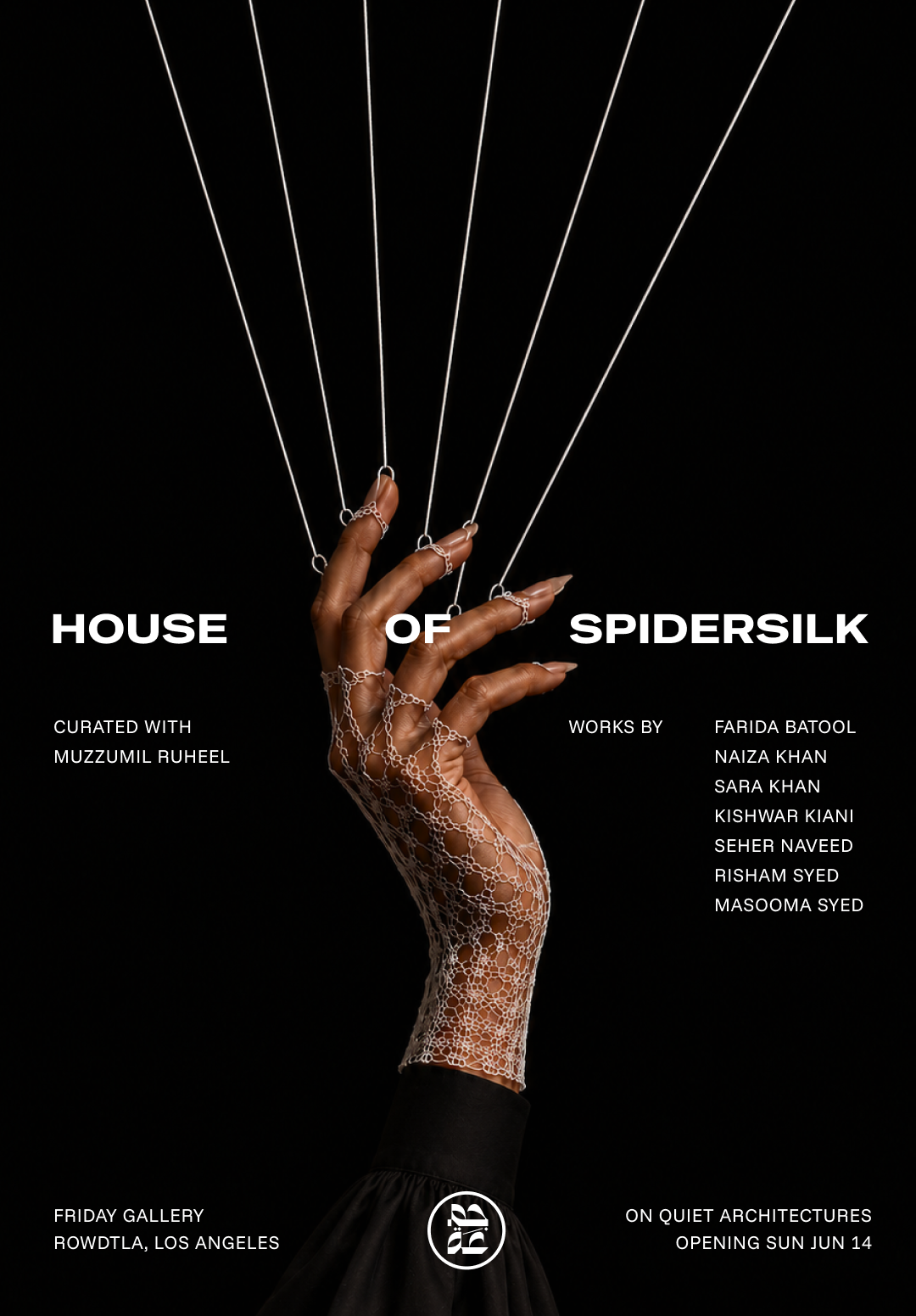
An exploration of the invisible structures that hold us: the quiet architectures of body, land, ritual, and memory.
Not everything that holds us is visible. Some structures live in memory and ritual. Some in body and land. Some in the spaces we move through without noticing, and the intimate objects we carry close. We inherit them before we can name them. House of Spider Silk explores the unseen systems that bind, bond, and sustain us: quiet architectures that hold us together, and sometimes harden around us.
Across textile, sculpture, photography, and painting, the works move between intimate and collective forms of holding. The artists reveal the strength of these tender forces through precise and gestural explorations of line, boundary, perception, and form. Borders shift with perspective, mental structures are frozen into metal scaffolds, submerged landscapes drift in and out of memory, and sacred objects take on mythic charge. The works share a language of restraint, intention, and attention: asking us to slow down, look deeper, and look beneath. Every gesture, fragment, and material carries weight.
Beneath the exhibition is an unspoken thread: the fragile space between being held and being bound. Too little and we drift untethered. Too much and we can’t breathe. Every attachment has a price. The question is how much we are willing to give.
___
HOUSE OF SPIDER SILK
Curated with Muzzumil Ruheel
On View June 14– Aug 31, 2026
with Farida Batool, Naiza Khan, Sara Khan, Kishwar Kiani, Seher Naveed, Risham Hosain Syed, and Masooma Syed
A Study of Invisible Architectures
in 7 Chapters
Farida Batool's work is rooted in the land of Pakistan - its beauty, its layered histories of urbanization, its longings and loss, extending to the invisible political geometries that scar the subcontinent: the Line of Control, the partitioned body, the divided land. She describes herself as a flâneur navigating the city's everydayness, alert to the way ordinary surfaces (a brick wall, a street, a reflection) hold years of history beneath the surface.
Batool’s lenticular prints hold two truths at once. The photographs shift as the viewer moves, collapsing the body into landscape and revealing borders as unstable, constructed fictions. Her work implicates the act of looking itself, where every position reveals and erases simultaneously. You cannot look without choosing an angle, and every angle reveals a different truth.
In Batool’s work, the ground shifts, resists, and remembers what came before. Bodies blur into terrain. Each position reveals a different reality, never allowing the image to settle into a single truth. These are not natural divisions. They are imposed, drawn across political land, across bodies, across histories. Her work makes this visible, but never fully settles it.
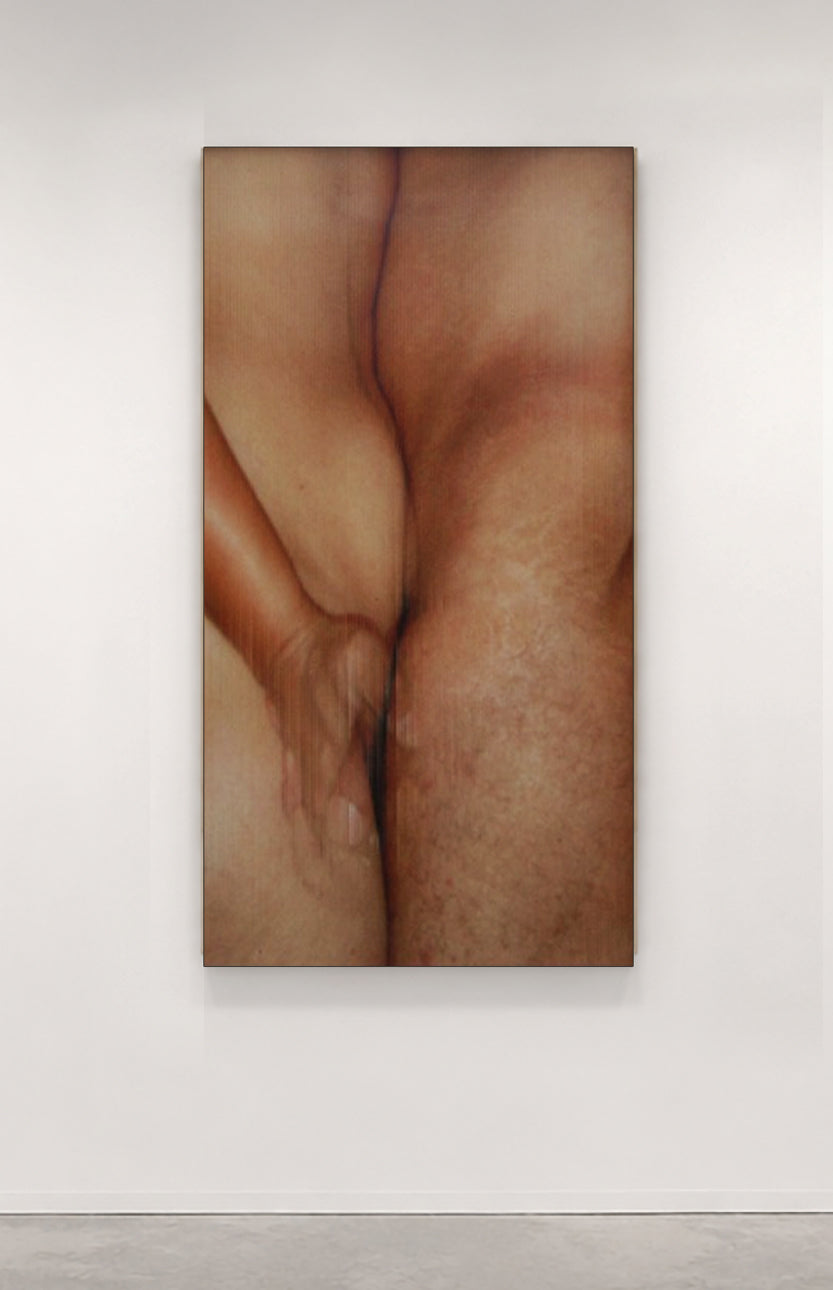

Line of Control
34"×62"
Photographs on Lenticular Print
Final Edition / Artist Print for Institutional placement
2024
PRICE ON REQUEST
"In this work, I have used the line that forms and remains between two bodies even after an intimate union and appropriated it with the geo-political construction of two neighboring countries. The desire to control, overpower, experience, touch, fear, to hold and to hold back, are some of the feelings that keep each individual separate from the other."
Farida Batool
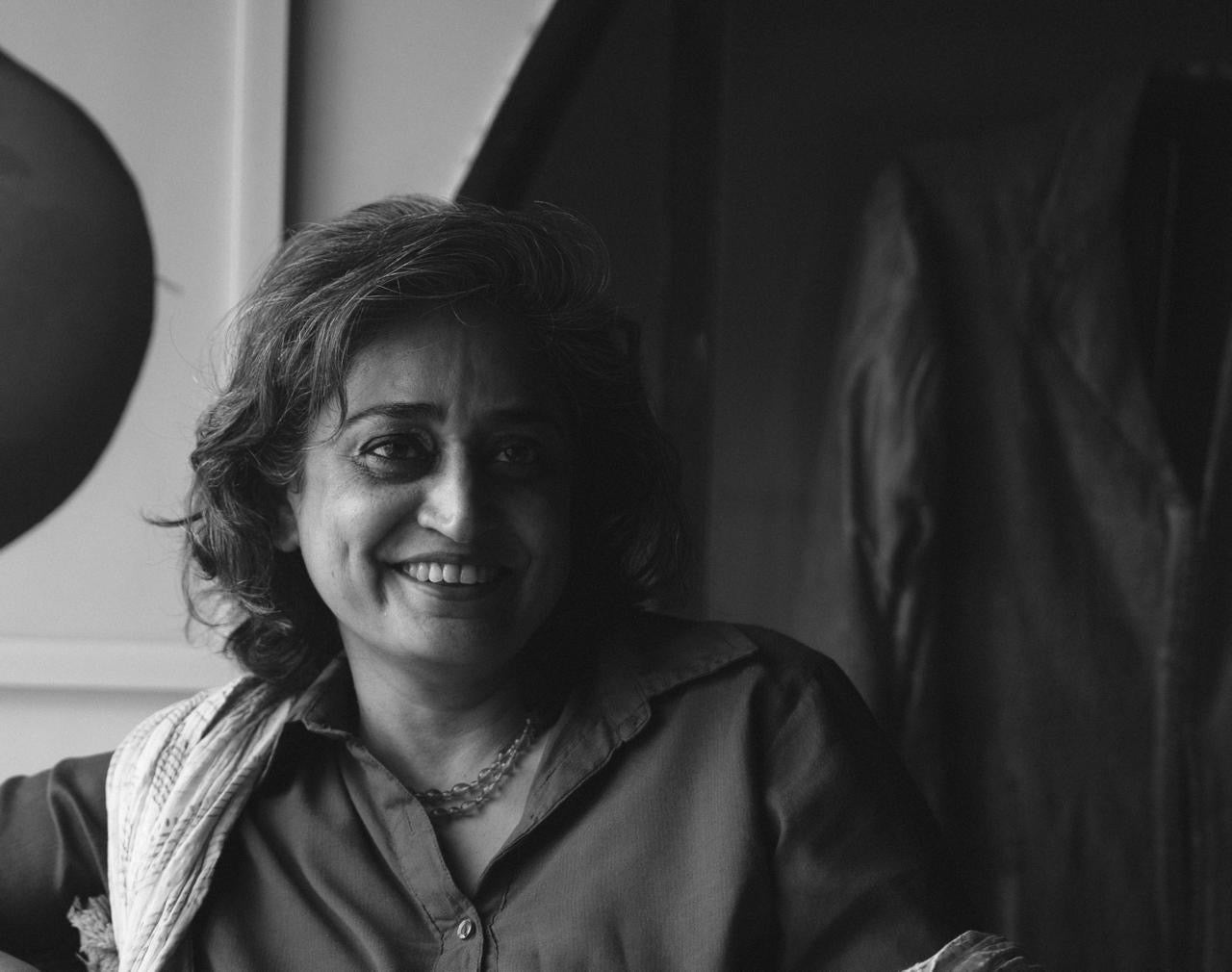
Farida Batool is a visual artist interested in exploring Pakistan’s political upheavals and tumultuous history, and developing a comprehensive cultural critique of everyday life. She received her BA in Fine Arts from the National College of Arts, Lahore, her MA in Art History and Theory from COFA at the University of New South Wales, and her PhD from the Centre for Media Studies at SOAS, London.
She has been teaching since 1997 and currently is the Dean of Faculty of Humanities, at National College of Arts, Lahore. Batool’s work has been exhibited locally and internationally in institutions such as the Singapore Art Museum, Whitechapel Gallery in London, Aicon Gallery in New York, The National Gallery of Modern Art in Mumbai, Portimao Museum in Portugal; Rohtas Gallery, Lahore; Green Cardamom, London; Third Line, Dubai; The Devi Art Foundation, Gurgaon; and The Herbert F. Johnson Museum of Art, Ithaca.
She is an active member of Awami Art Collective which aims to use art in public spaces to generate a discourse of peaceful co-existence. She was involved in many art projects and community workshops for awareness raising among women communities in several urban and rural areas of Pakistan as well as conducted cultural and political dialogue among different communities. Batool presented papers and presentations at international conferences and workshops including Yale University USA; Society for Cinema and Media Studies, Montreal, Canada; Oxford University, St. Joseph’s University Philadelphia and many more.
Naiza Khan’s works are images submerged in memory, and excavated from the deep. For decades, Khan has returned to the fragile edges between land, body, history, and disappearance. Her works speak to Karachi’s coastal geographies and places shaped by colonial histories, military presence, environmental erosion, and long cycles of survival. Erosion, absence, and abandonment become their own forms of architecture: a reminder that spaces and bodies can not help but be timekeepers.
“I began to think about the depths we search to find the shipwreck, to find love, the objects we carry across the ocean to other lands. These conceptual drawings reflect on the sedimented nature of objects in the depths of the ocean. The intimate pull between object, material and nature fuses and erases the differences of place and identity and becomes a site of confluence and transformation.”
In her works, spaces hold the past like a grandmother would clutch an old story close, to be retold over and over again. Body becomes ocean, form becomes liquid, and “vessel morphs into something fleshy.” Fragments of scaffolding, architectural traces, and submerged forms drift in and out of visibility, dissolving into water, dust, and memory. The patina of time shows her hand.
Khan often speaks about being drawn to places “on the edge”: coastlines, islands, thresholds, and spaces suspended between presence and absence. That sensibility runs throughout these works. Her works move like tides: revealing, obscuring, returning again. What is missing becomes as important as what remains.
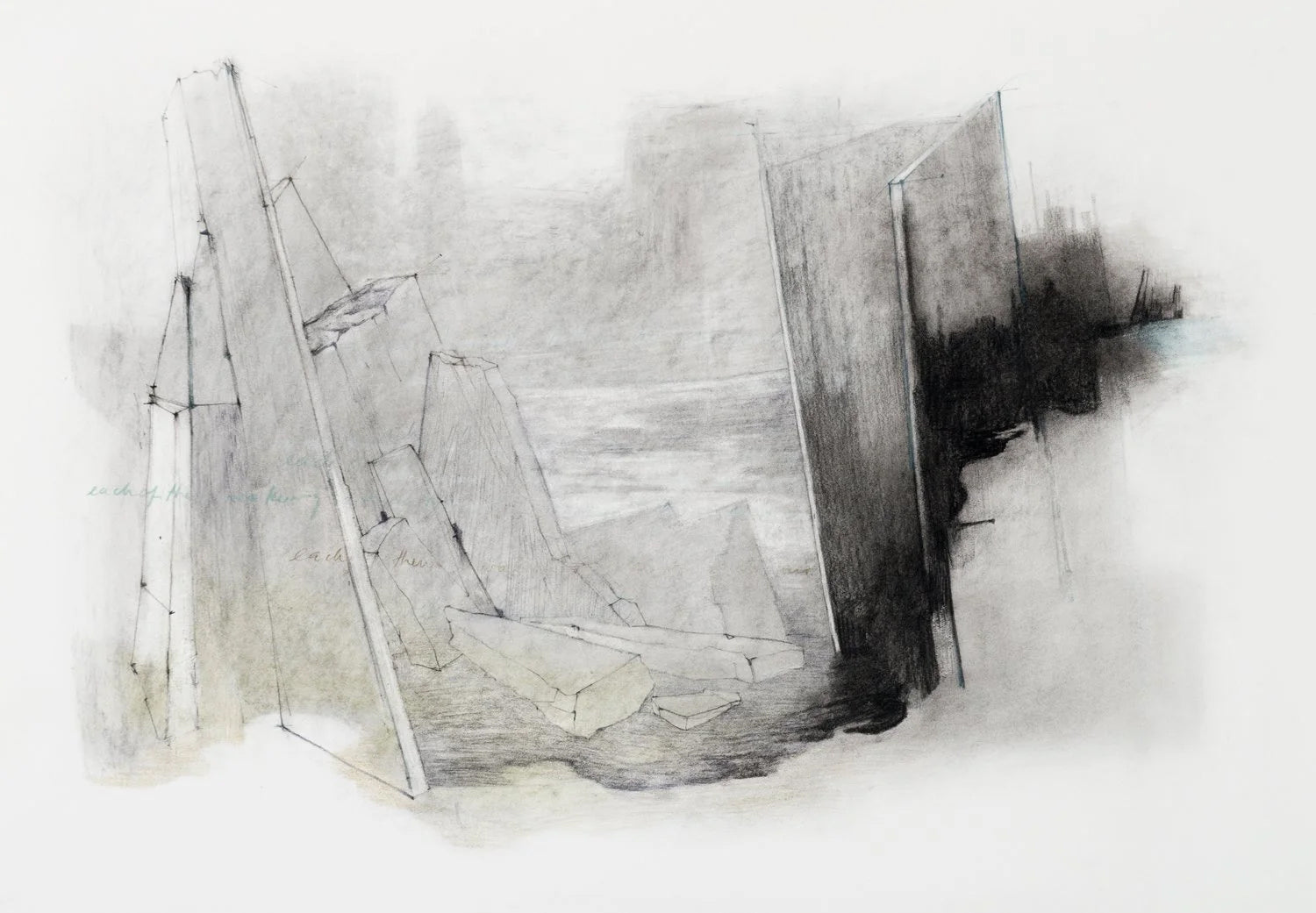
Blessed Conquest (Objects from the Deep)
27.5”x 39.3”
Charcoal, Conté and graphite on paper
2016
PRICE ON REQUEST
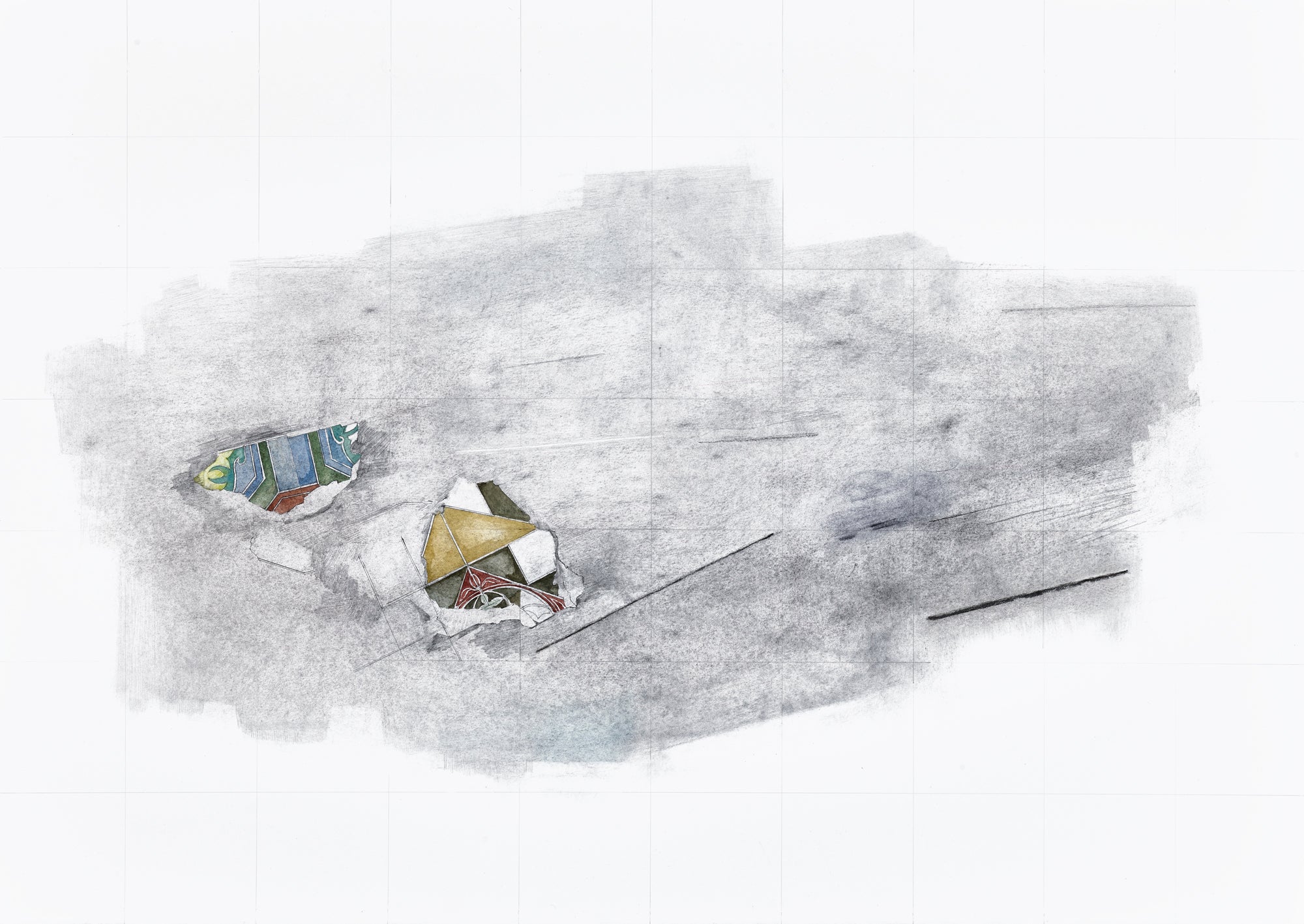
Debris (Objects from the Deep)
28” x 39½"
Graphite and watercolor on paper
2019
PRICE ON REQUEST
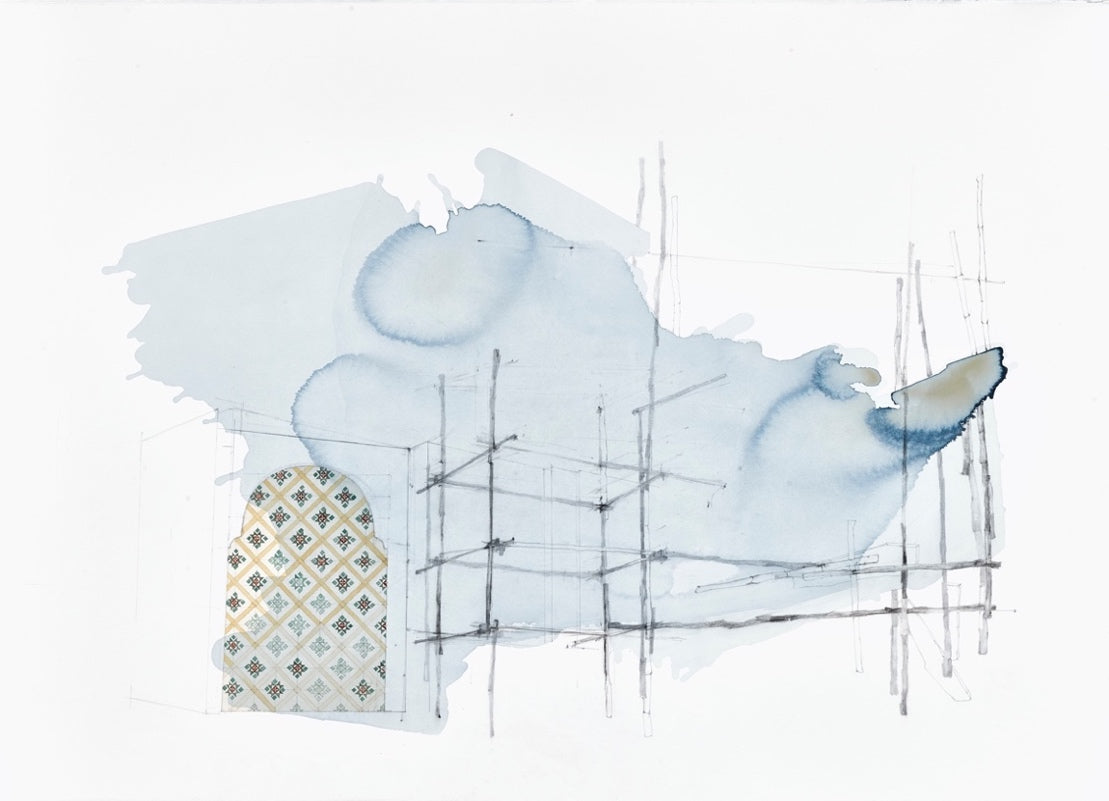
Cloud Scaffolding
29.5'' x 42''
Watercolor on Magnani paper
2019
PRICE ON REQUEST
Naiza Khan
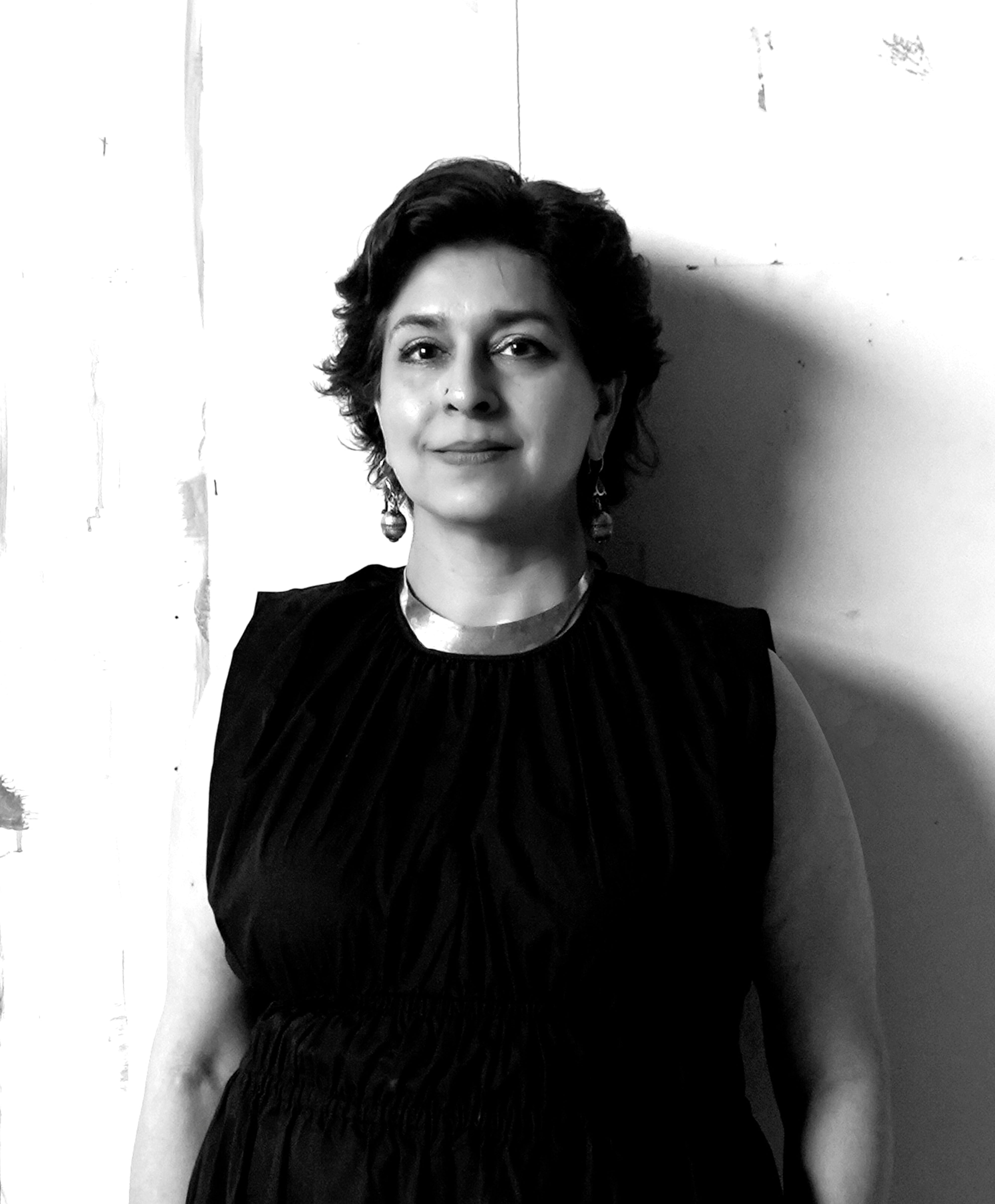
Born in Pakistan in 1968, Naiza Khan trained at the Ruskin School of Drawing and Fine Art, University of Oxford, and the Wimbledon College of Art, London. Her work has been widely exhibited internationally, including at the Kochi-Muziris Biennale (2016), the Colombo Art Biennale (2016) and the Shanghai Biennale (2012), as well as in exhibitions, such as Hanging Fire: Contemporary Art from Pakistan, Asia Society, New York, USA (2009); Art Decoding Violence, XV Biennale Donna, Ferrara, Italy (2012); Desperately Seeking Paradise, Art Dubai, UAE (2008); Manifesta 8, Murcia, Spain (2010); and the Cairo Biennale, Cairo, Egypt (2010).
Khan was selected for Pakistan's inaugural national pavilion in the 58th Venice Biennale in 2019. She was also selected for residencies at Gasworks, London, UK, and at the Rybon Art Center, Tehran, Iran. As a founding member and long-time coordinator of the Vasl Artists’ Collective in Karachi, Khan has worked to foster art in the city, and participated in a series of innovative art projects in partnership with other workshops in the region, such as the Khoj International Artists’ Association, New Delhi, India; the Britto Arts Trust, Dhaka, Bangladesh; the Sutra Art Foundation, Kathmandu, Nepal; and the Theertha International Artists Collective, Colombo, Sri Lanka. In addition, she has curated three exhibitions of Pakistani contemporary art, including The Rising Tide: New Directions in Art from Pakistan, 1990–2010 at the Mohatta Palace Museum, Karachi.
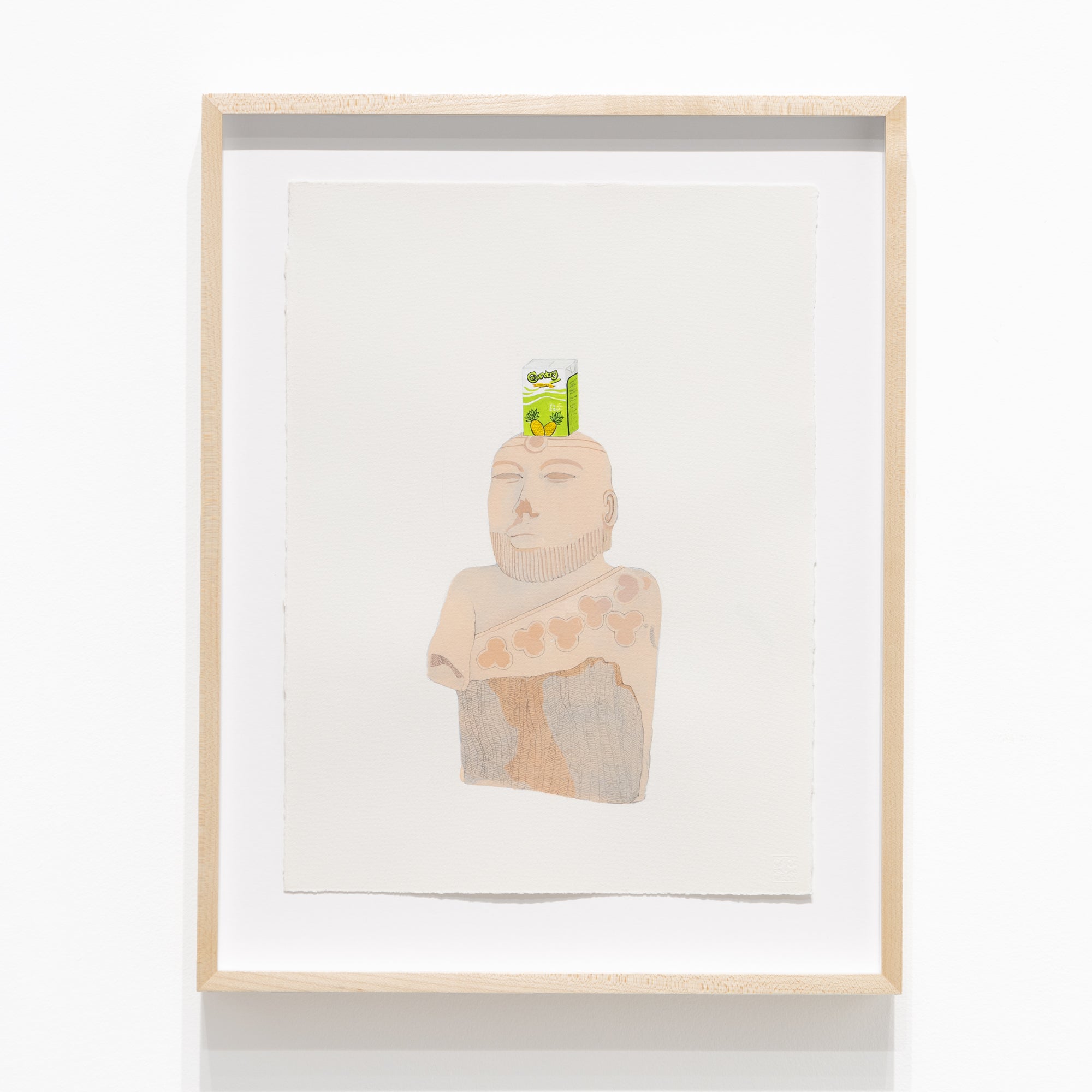
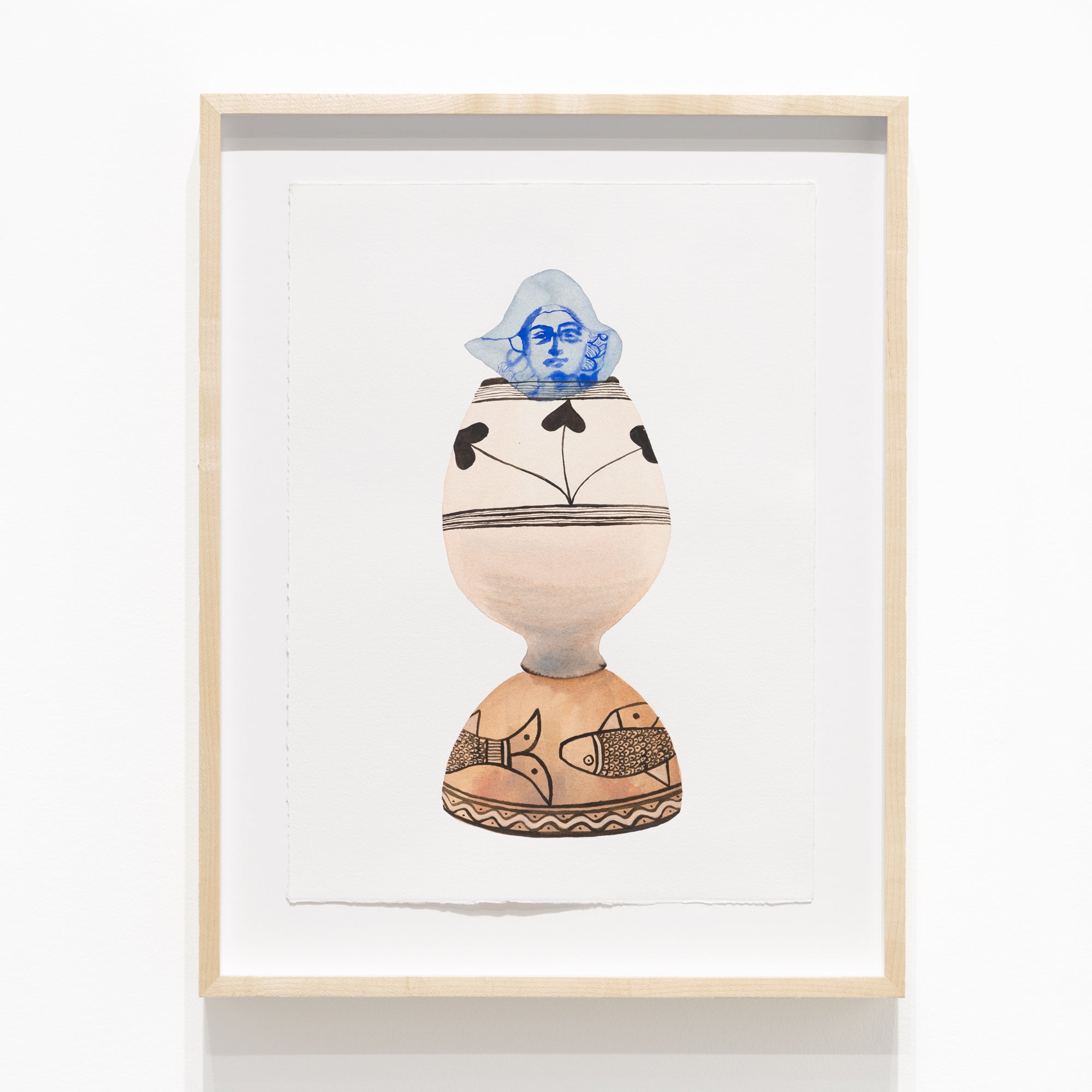
Sara Khan creates works that exist in the charged space of betwixt and between. Her ceramic sculptures and paintings are populated by hybrid figures, intersectional bodies, and symbolic vessels in the process of shifting into something else entirely.
Khan is known for her explorations of magic realism and the blurred lines between the real and imagined. The use of watercolors allows her to work with transparency and layering, qualities that mirror the intersecting emotions her work explores. Khan views the medium as an extension of her body: "Delicate but resilient, capable of holding a range of emotional and visual intensity." In one work, generations of female heads stack like a totem, rested upon each other and supported by the weight of those who came before. In another, a protective crocodile with watchful eyes blends softness with strength, alive with the feral energy of motherhood.
Khan draws from migration, mythology, colonial conquest, and the emotional instability of living between culture and identities, building what she describes as “new mythologies from fragments.” Her forms carry the strange emotional logic of dreams, where architectures of meaning overlap rather than resolve. The simple truth is that we are always more than one thing, and never entirely finished.
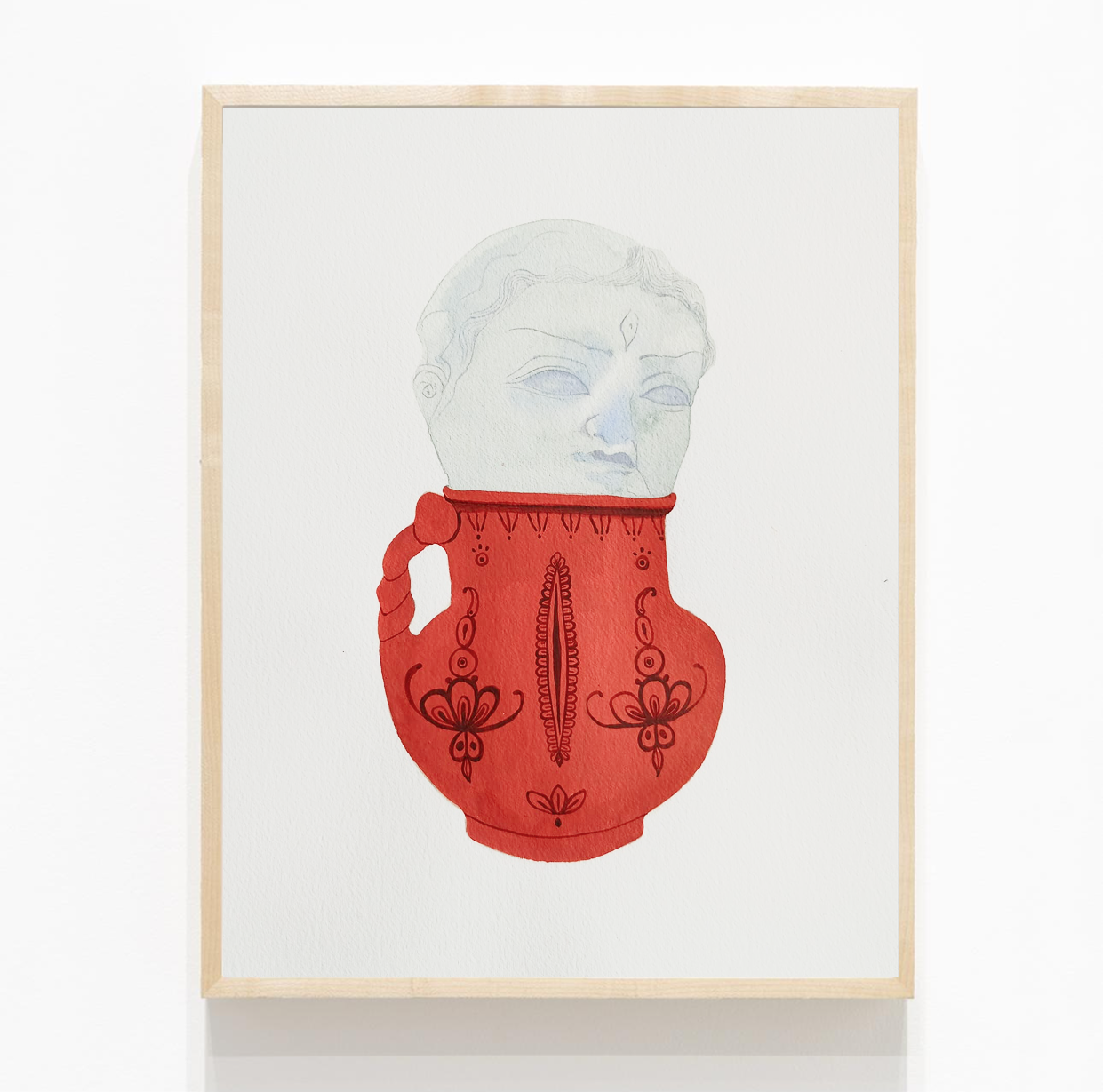
We Drowned In Their Relics
15" x 11"
watercolor on paper
2025
Image courtesy of Zalucky Contemporary
PRICE ON REQUEST
We Trashed Our Relics
15" x 11"
watercolor on paper
2024
Image courtesy of Zalucky Contemporary
PRICE ON REQUEST
Stack
15" x 11"
watercolor on paper
2024
Image courtesy of Zalucky Contemporary
PRICE ON REQUEST
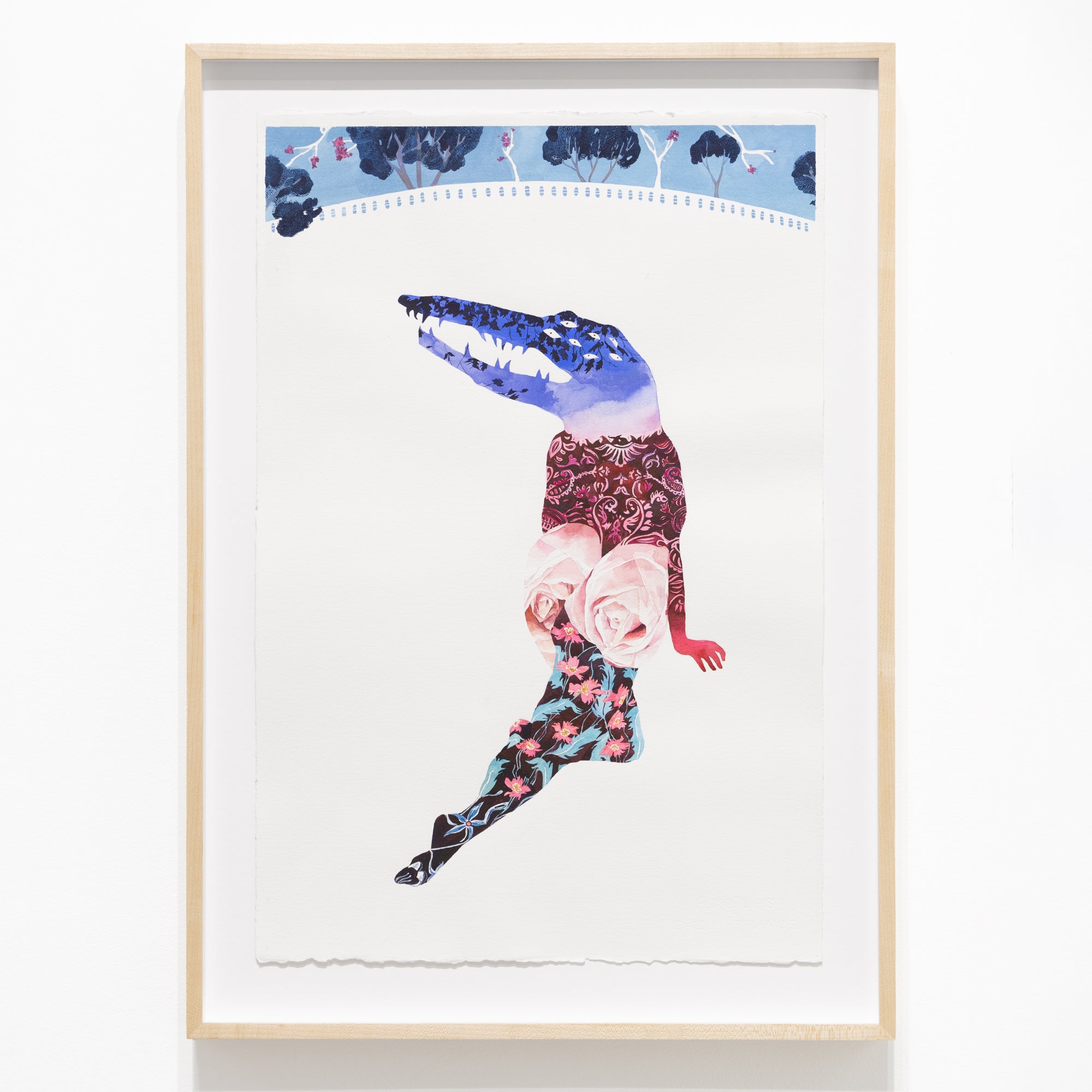
Performance on the Terrace - Magar Mach Ke Ansoo (crocodile tears)
22" x 15"
watercolor on paper
2020
Image courtesy of Zalucky Contemporary
PRICE ON REQUEST
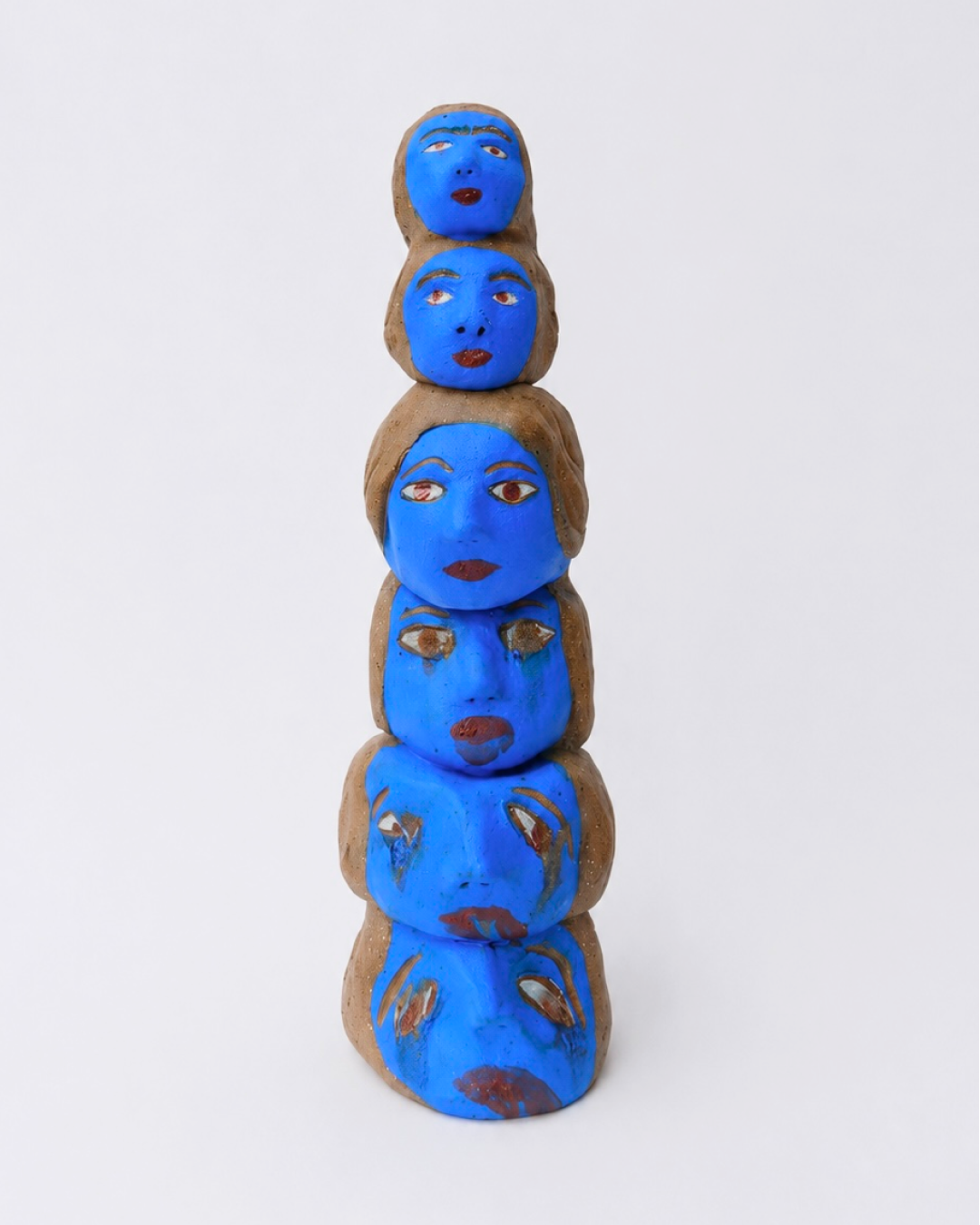
Those Who Came Before Us
2" x 2" x 7"
Ceramic clay, underglaze, and clear glaze
2024
Image courtesy of Zalucky Contemporary
PRICE ON REQUEST
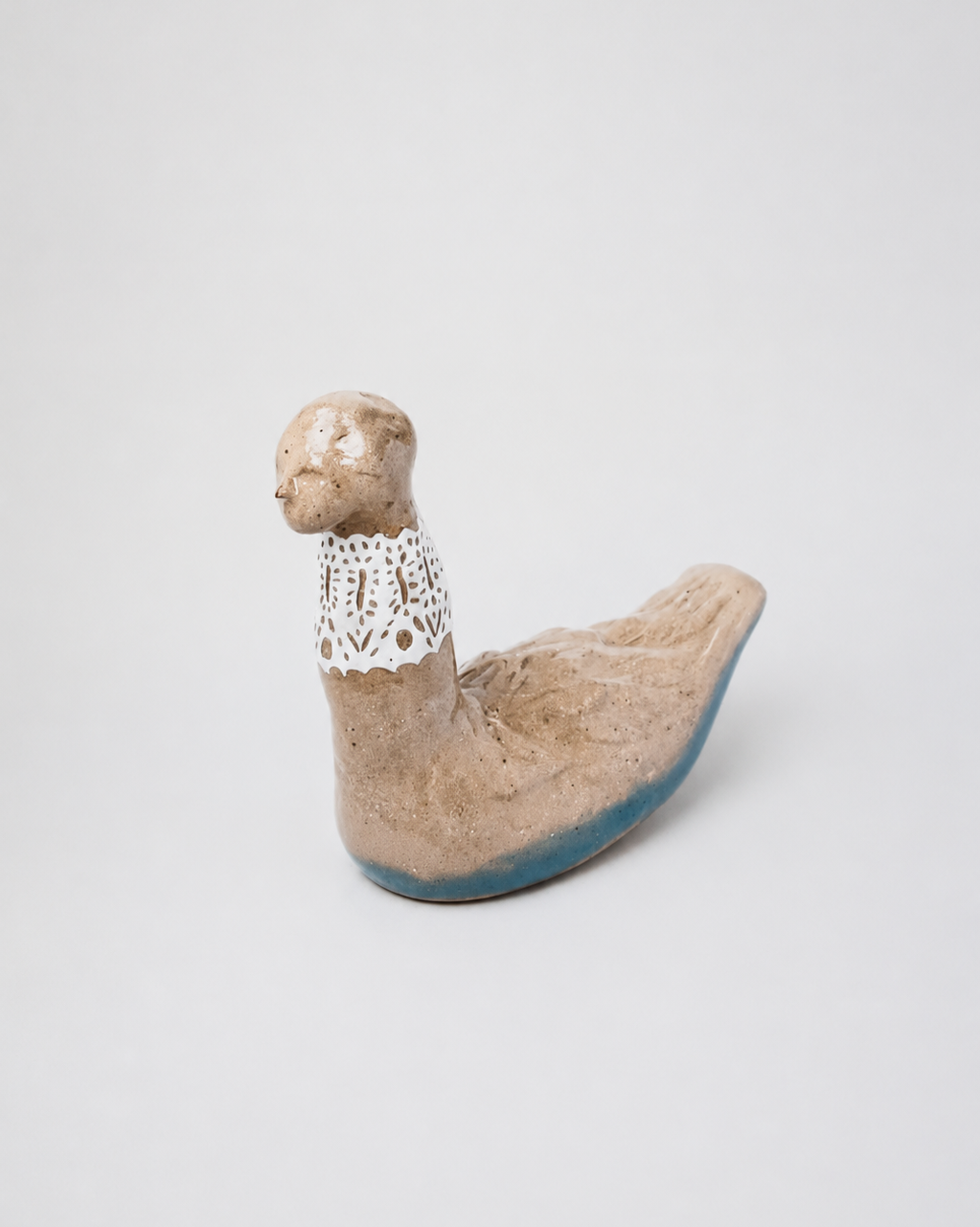
Pigeon 1
5" x 5" x 3"
Ceramic clay, underglaze, and clear glaze
2024
Image courtesy of Zalucky Contemporary
PRICE ON REQUEST
Sara Khan
"My work explores the space between reality and fantasy through an autobiographical lens, drawing on themes of migration, heritage, and the feminine experience. Working primarily with watercolour on paper, textiles, and ceramics, I create enveloping worlds of magical realism inhabited by hybrid forms, imagined landscapes, and ornamental flora. Figures often emerge from dense patterned environments, hovering between concealment and revelation, reflecting the fluid and evolving nature of identity.
Much of my recent work revolves around hybridity and transformation. I am drawn to what we become after an evolutionary experience. What motherhood might entail, turning us into a creature with two heads and four limbs between them; or how migration might affect us: the precarity we straddle, how we adapt, and the form we might take once we make it to the other side. Transparency, layering, texture, and tactility play a central role in my practice, allowing me to explore vulnerability alongside resilience. Ultimately, I am interested in what we are left with once we survive."
___
Sara Khan is a recipient of the Elizabeth Greenshields grant (2023) and was artist-in-residence at The Burrard Arts Foundation (2021). She has presented solo exhibitions at Zalucky Contemporary, Toronto (2024), The Reach Gallery Museum (2021) and The Surrey Art Gallery (2019). She also participated in Plural Contemporary Art Fair (2024). Select group exhibitions include “Let Me Take You There” at The Doris McCarthy Gallery, Scarborough, ON (2023) and “Hope”, Two Rivers Gallery, Prince George, BC (2022).
Khan works with watercolour, textiles, and ceramics, exploring magical realism and the shifting space between reality and imagination through themes of migration, heritage, and the feminine experience. Her work forms layered, hybrid worlds of figures, ornament, and mythic landscapes. Khan holds a Bachelor of Fine Art from The National College of Arts, Lahore. She lives and works in Vancouver, Canada.
Kishwar Kiani’s intricate metal sculptures and drawings explore the fragile scaffolding of the mind and the pressures formed by our inner architectures. Her entire practice is organized around an obsession with structure under pressure, where order and chaos coexist. Kiani’s pieces are "gigantic scaffolding in perpetual creative movement: building, renovating, elevating but also obliterating. What contains something shapes it just as much as what builds it."
Kiani builds dense, interwoven structures that exist in delicate tension. Each line depends on another, each point of connection carrying weight.They evoke scaffolds, nests, nervous systems, and neural connections: mental architectures we cannot see, but move within every day.
Her drawings follow a similar rhythm. Lines accumulate, fracture, and expand, mapping the movement of thought as structured yet constantly shifting. Precise, obsessive line-work accumulates into forms that seem to be either assembling themselves or coming apart, depending on where you stand.
She states “I want the viewer to feel like a bystander. Present for the collapse, unable to stop it, not sure they would even if they could. That uncertainty is not innocent.”

Air
13.8'' × 19.7'' × 15.7''
Stainless Steel
2005
PRICE ON REQUEST
"The work contrasts movement and containment, a space you can occupy yet never fully claim. The structure echoes the outline of a house, pressing a mobile tumbleweed into an architectural frame. In nature, a tumbleweed survives by rolling, but put it in one place, and that logic collapses. The tumbleweed doesn’t stop growing, it simply learns the shape of the container." - Kishwar Kiani
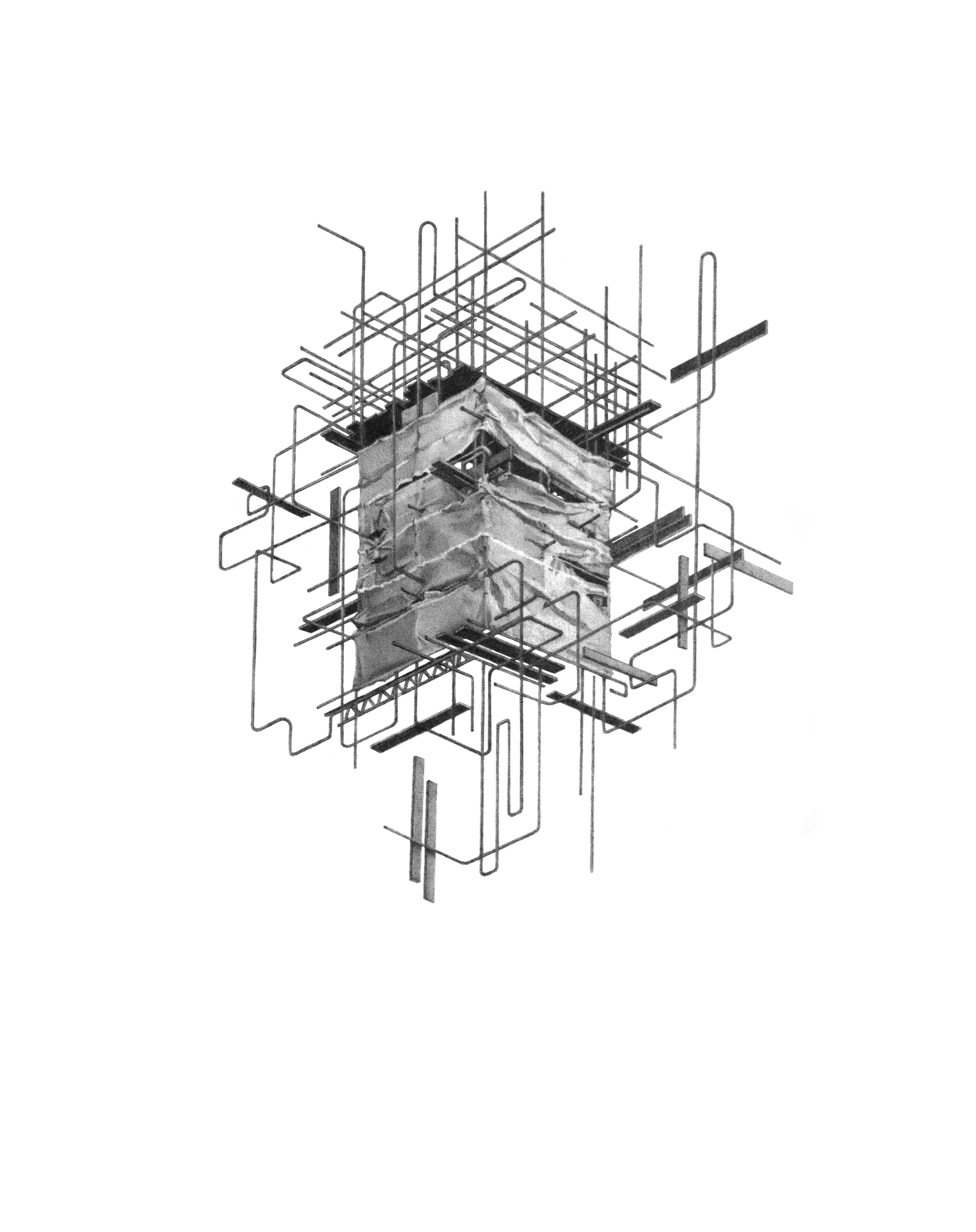
Plugged/Unplugged
(diptych)
15.7 in x 11.8 in
graphite on paper
2024
PRICE ON REQUEST
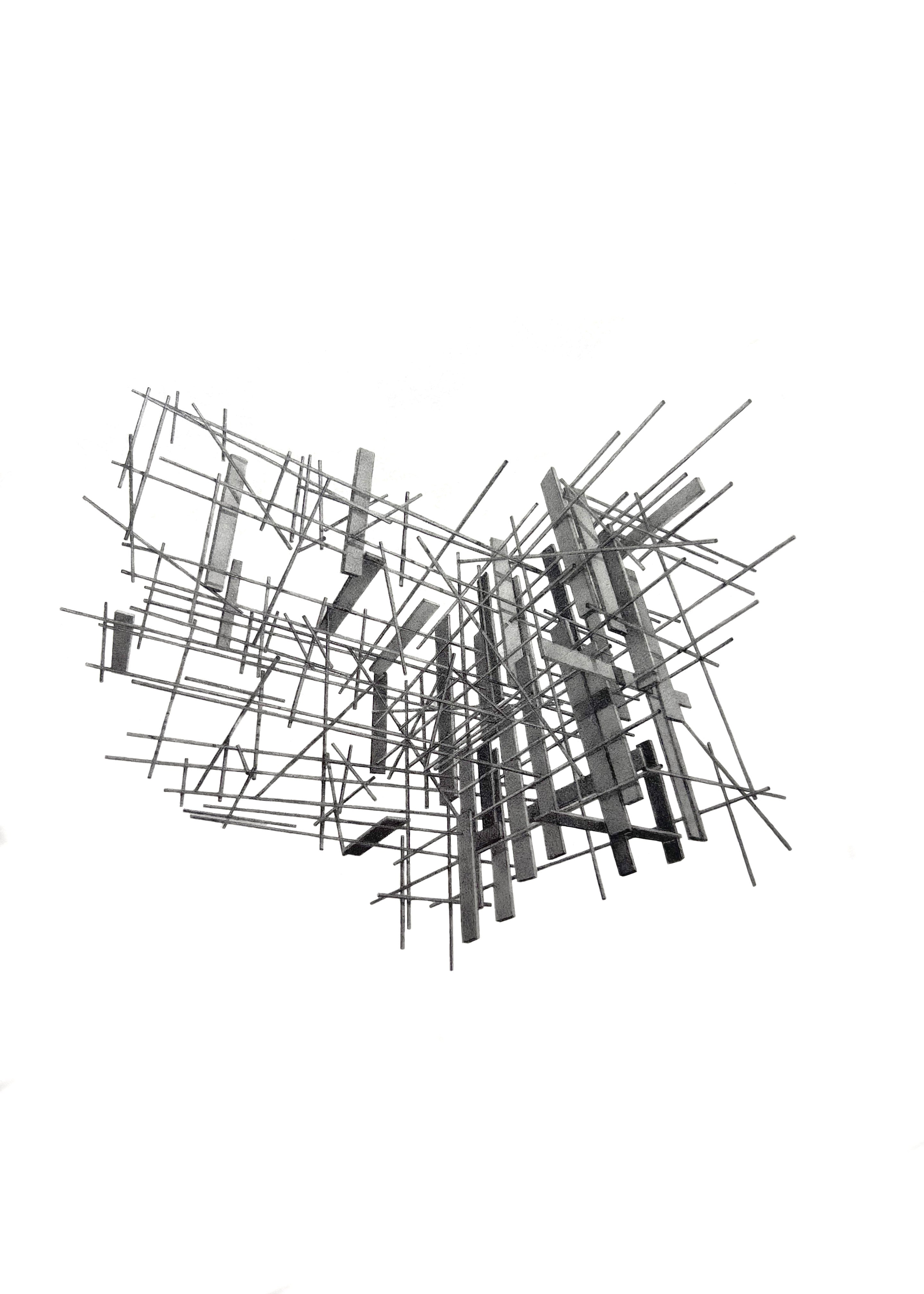
Plugged/Unplugged
(diptych)
15.7" x 11.8"
graphite on paper
2024
PRICE ON REQUEST
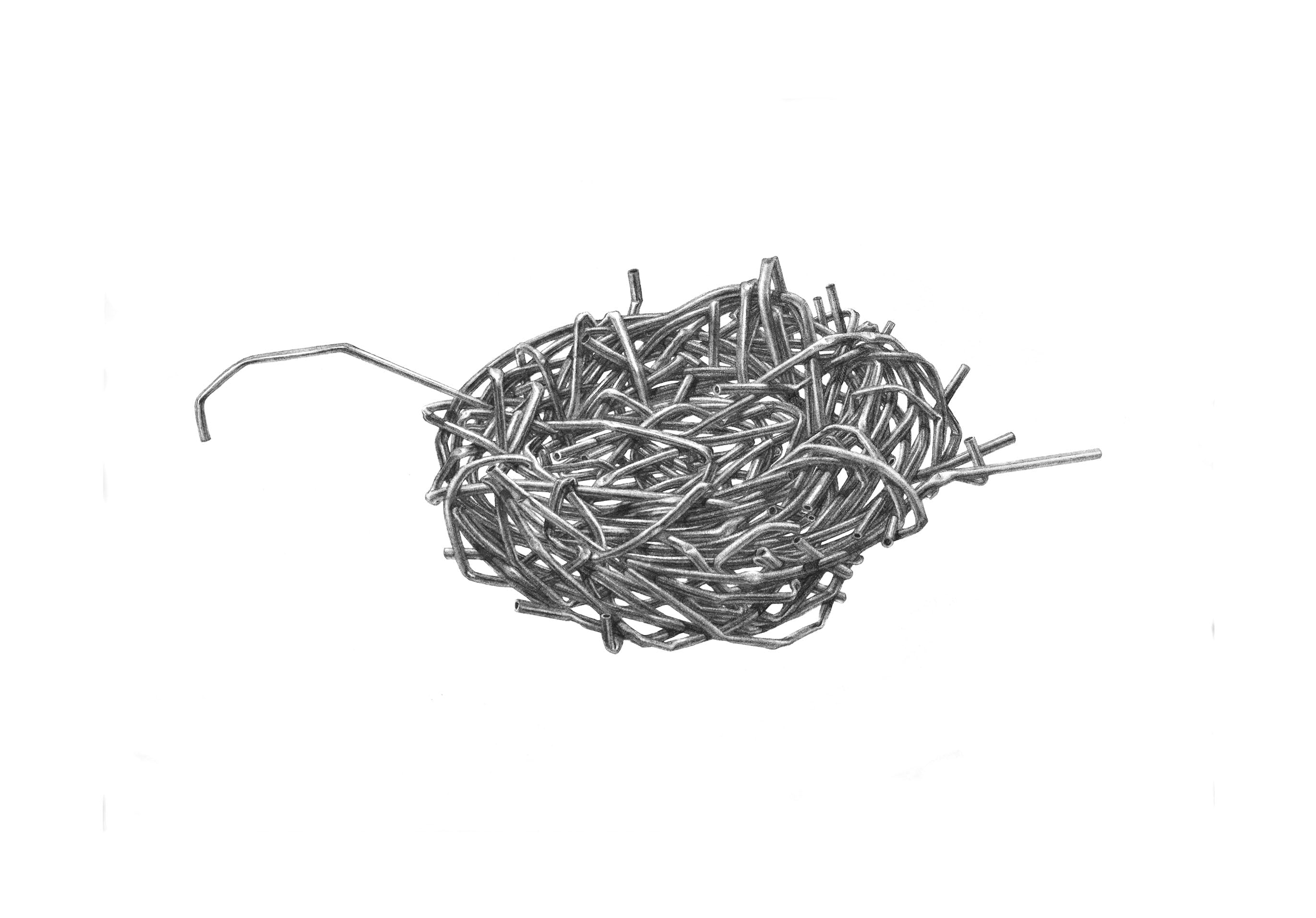
Round The Bend
15.7" × 11.8"
graphite on paper
2024
PRICE ON REQUEST
KISHWAR KIANI
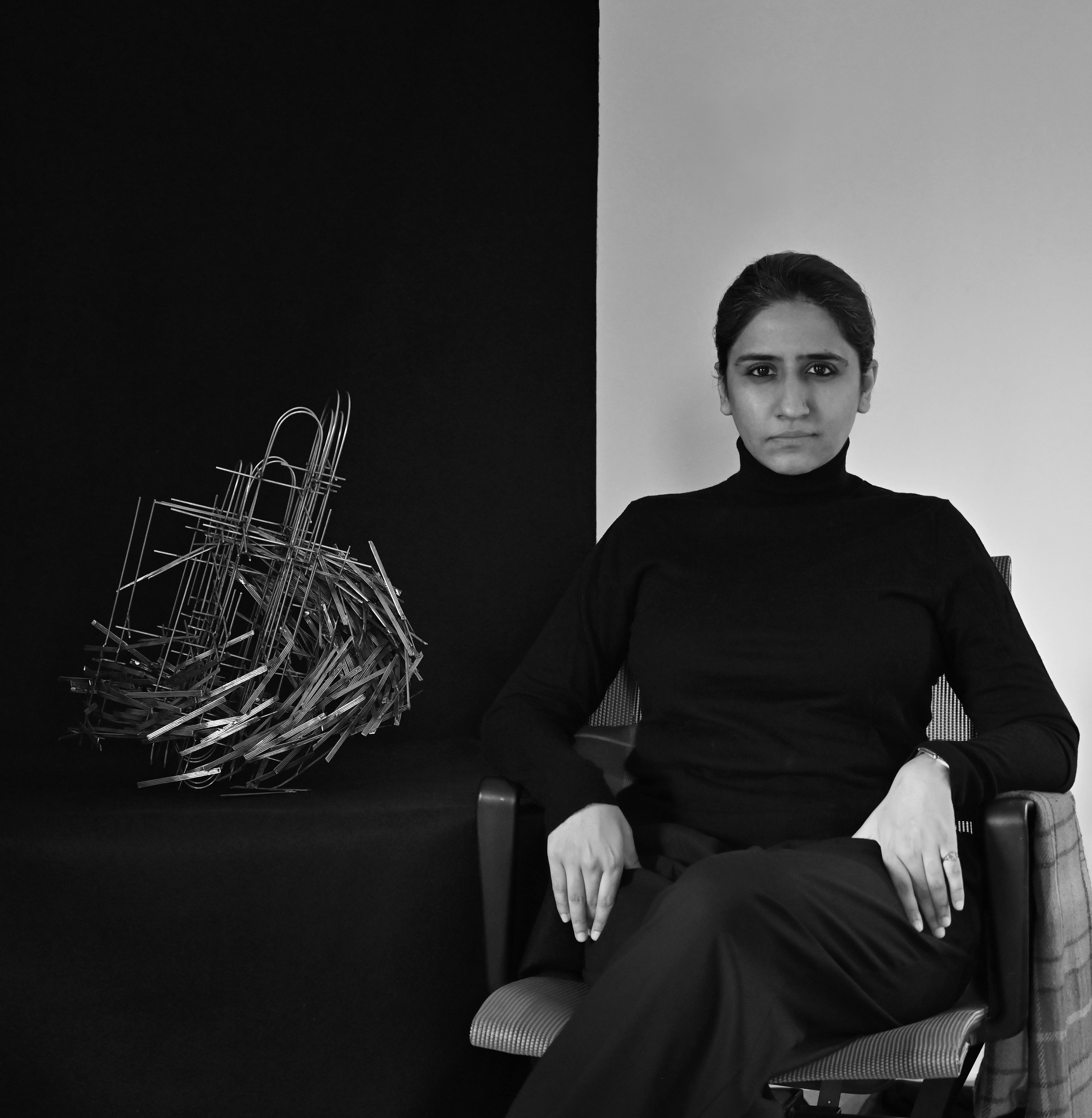
Kishwar Kiani GBA (b. Pakistan) is a visual artist and educator. She is a recipient of the Gilbert Bayes Sculpture Award and a Member of the Royal Society of Sculptors, London. A Chevening Scholar, she completed her MA in Drawing at Camberwell College of Arts, University of the Arts London. Her work has been exhibited internationally across London, New Delhi, Mumbai, Colombo and Lahore, including at the South London Gallery, Saatchi Gallery, the NCA Triennale at the National College of Arts and KALA South Asia.
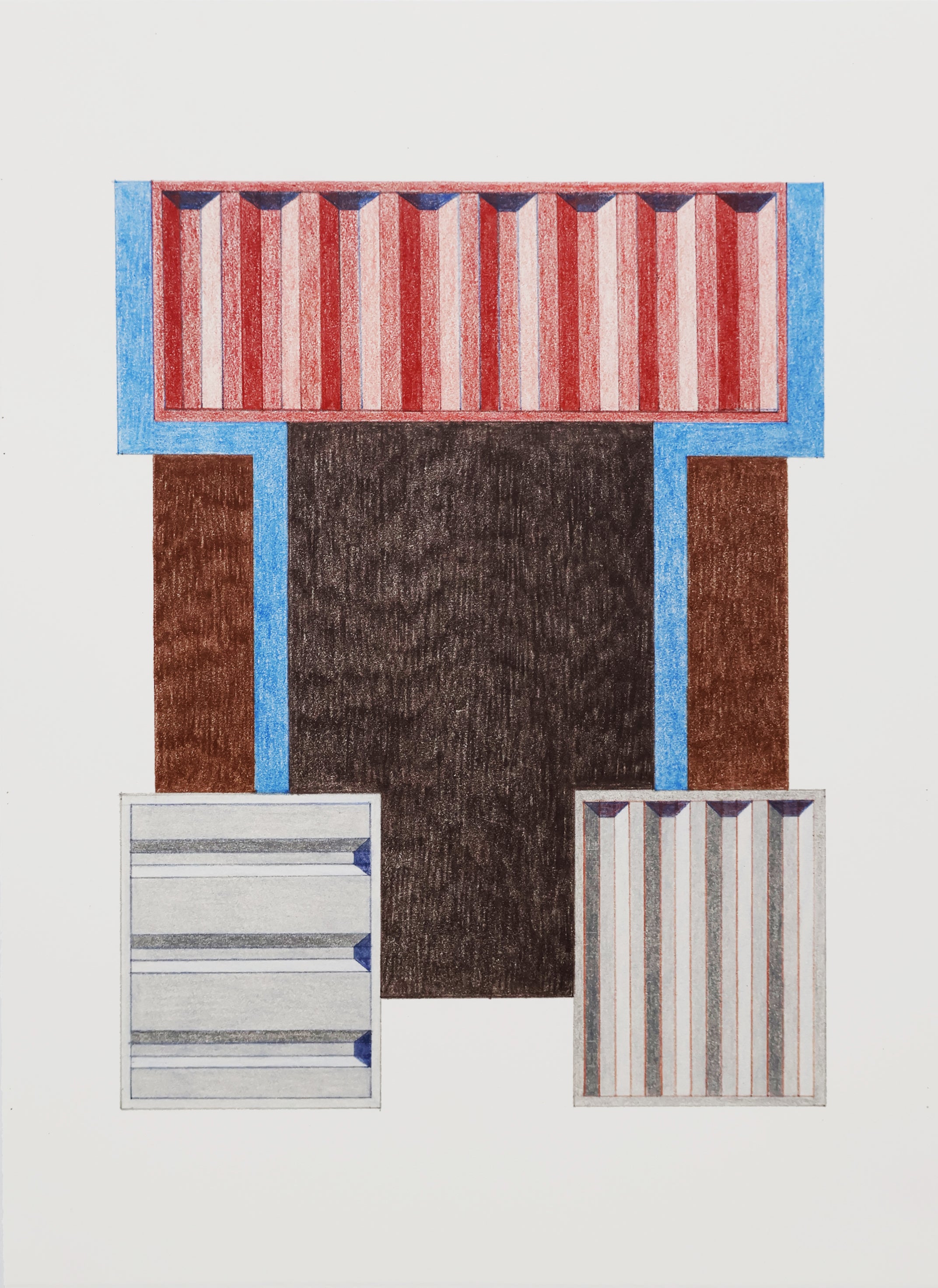
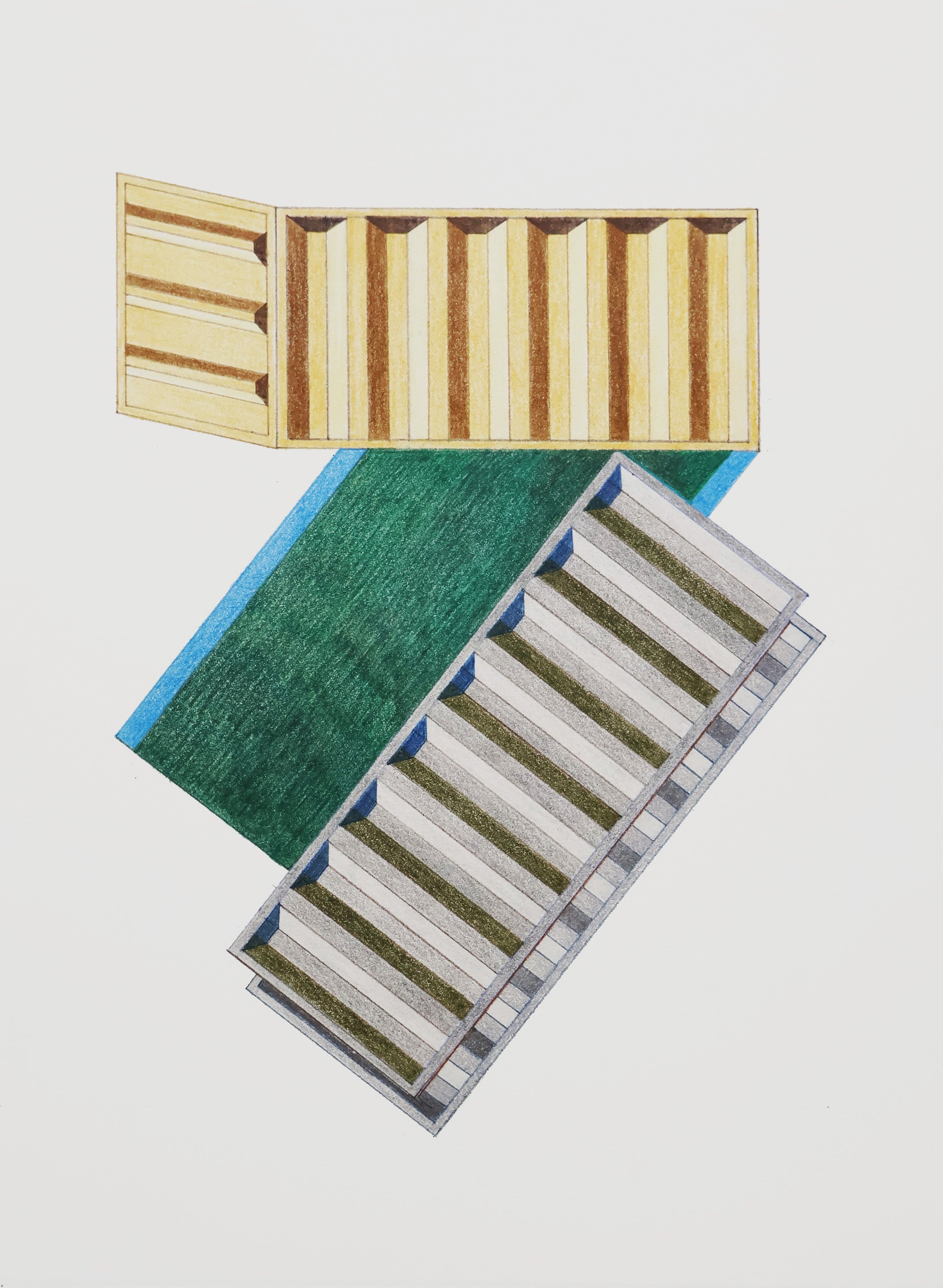
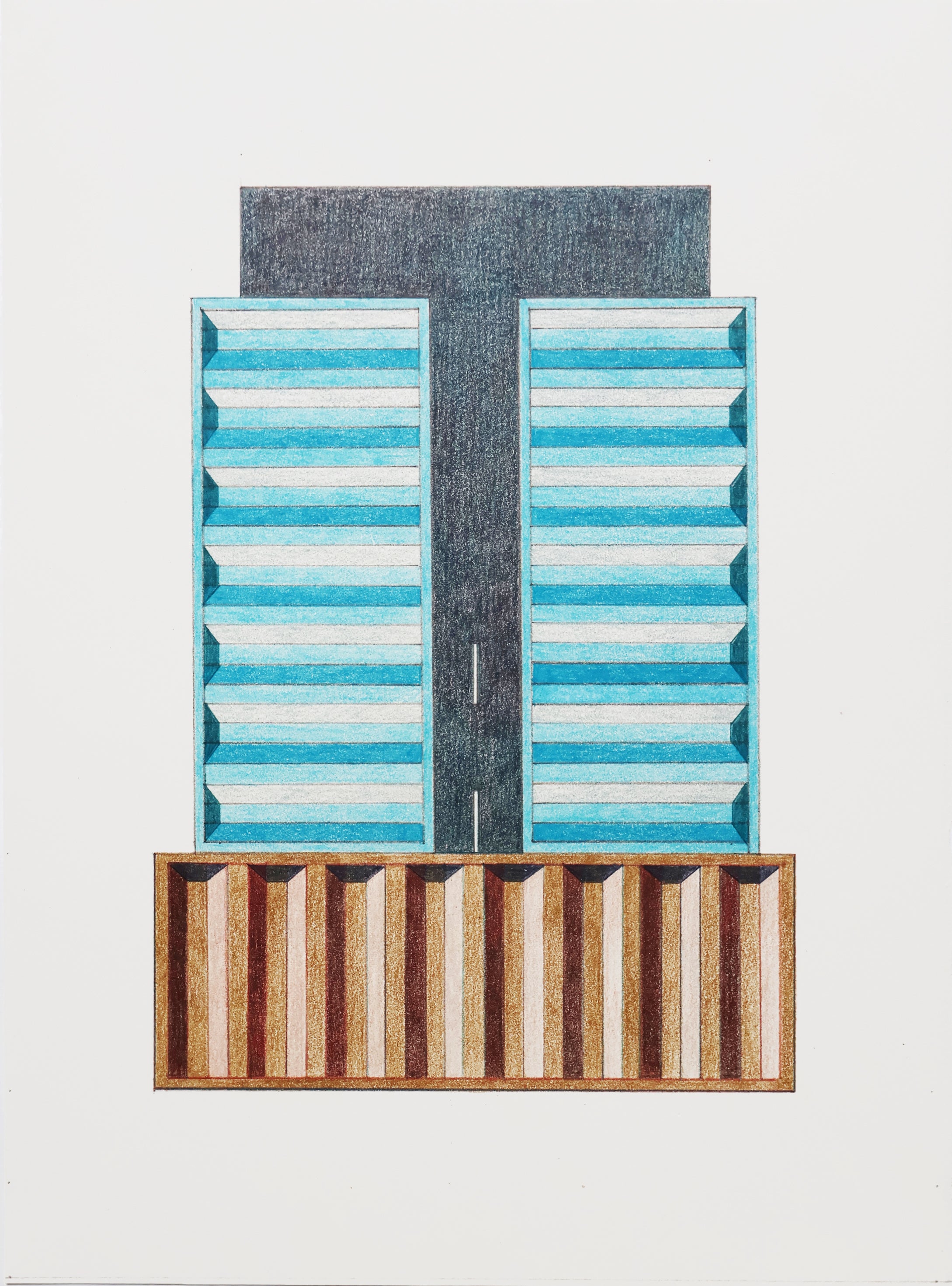
Seher Naveed explores how systems and structures reorganize space, restrict movement, and define access. Her work translates the architectural language of Karachi - its walls, gates, and barriers - into precise geometric abstractions and forms, making visible what we often glance past. She questions the fact that structures of private protection and social control become normalized, disappearing into the visual fabric of everyday life. No longer noticed, but deeply felt.
Naveed brings them back into focus, building an intentional contrast between their graphic beauty and their political weight. Flattened and precise, the architectural structures feel at once familiar and disorienting. Her colors are saturated and alive: deep blues, brick reds, forest greens, the warmth of raw wood. What could be bleak is instead visually exhilarating, which is exactly the friction she is after. Their beauty is part of the discomfort.
"My practice draws from the socio-political development of Karachi and the ways in which political instability reshapes how people move through, inhabit, and negotiate urban space. Using painting and drawing as primary methods, I investigate the built environment around me, particularly walls, gates, fences, grills, and other forms of enclosure that increasingly define the contemporary city. These structures interest me not only as architectural forms, but as markers of power, aspiration, protection, exclusion, and control.”
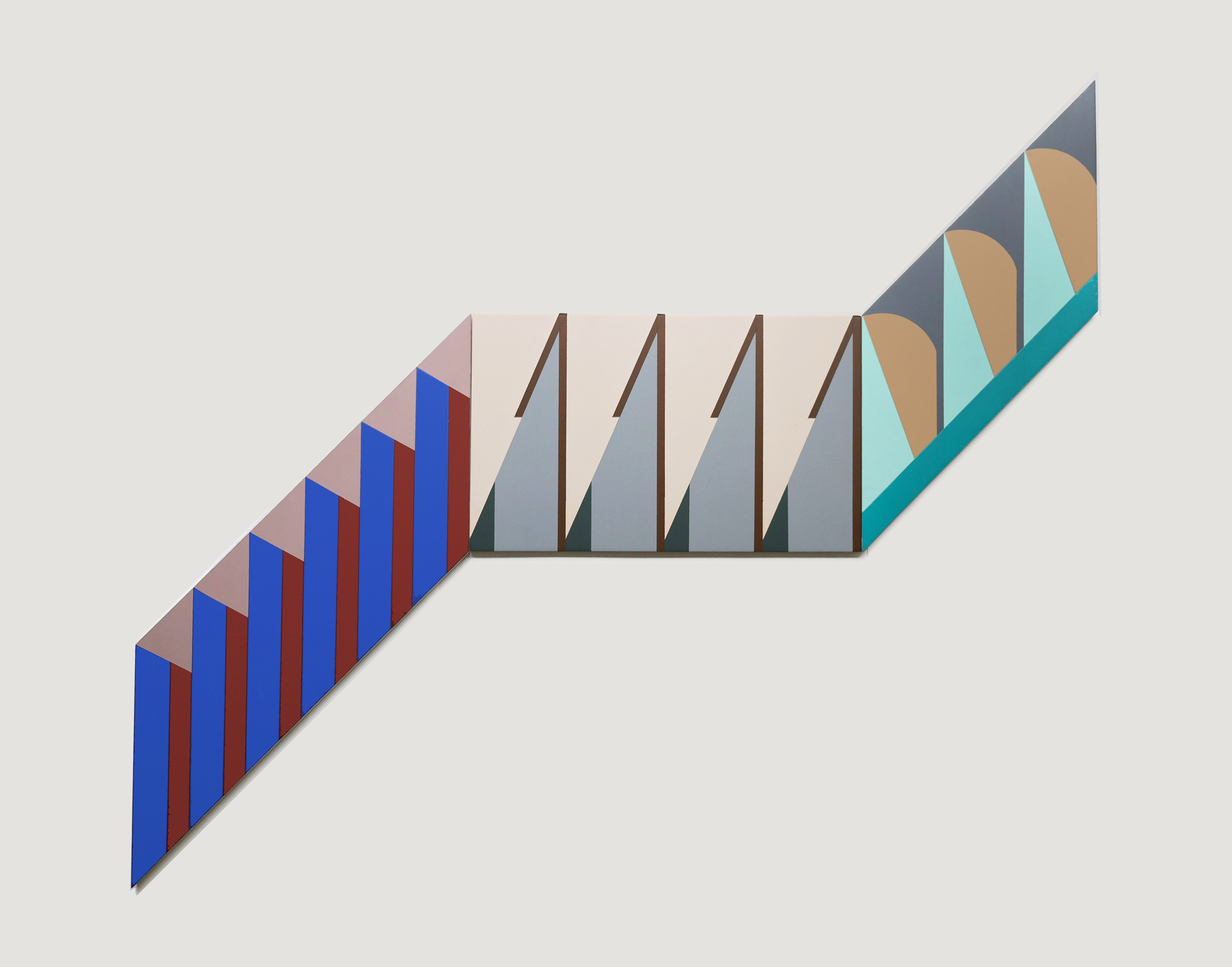
Shape Shifting: Untitled 15
40'' x 37.5''
Wall Paint on HDF
2025
PRICE ON REQUEST
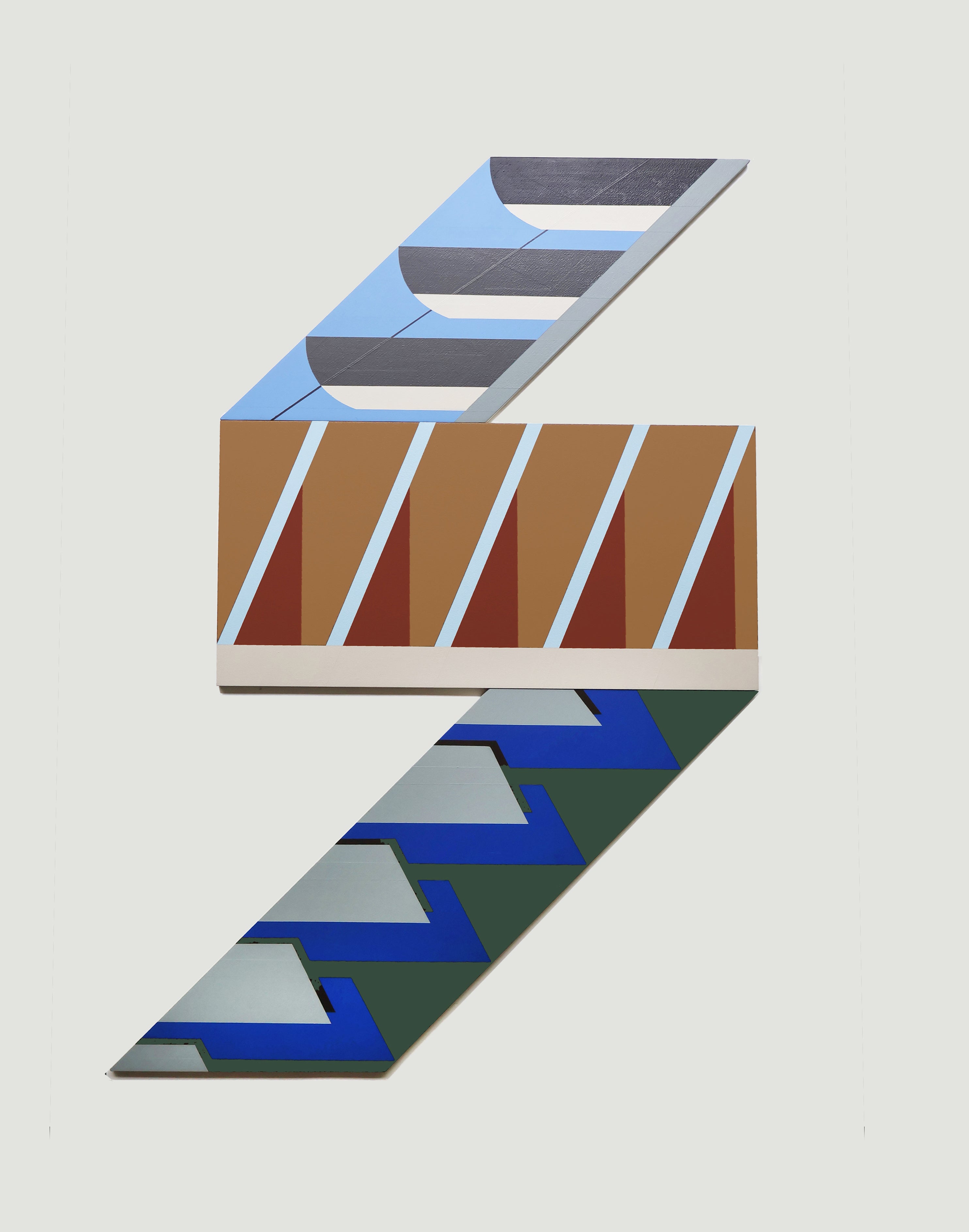
Shape Shifting: Untitled 18
28" x 41.5"
Wall Paint on HDF
2025
PRICE ON REQUEST
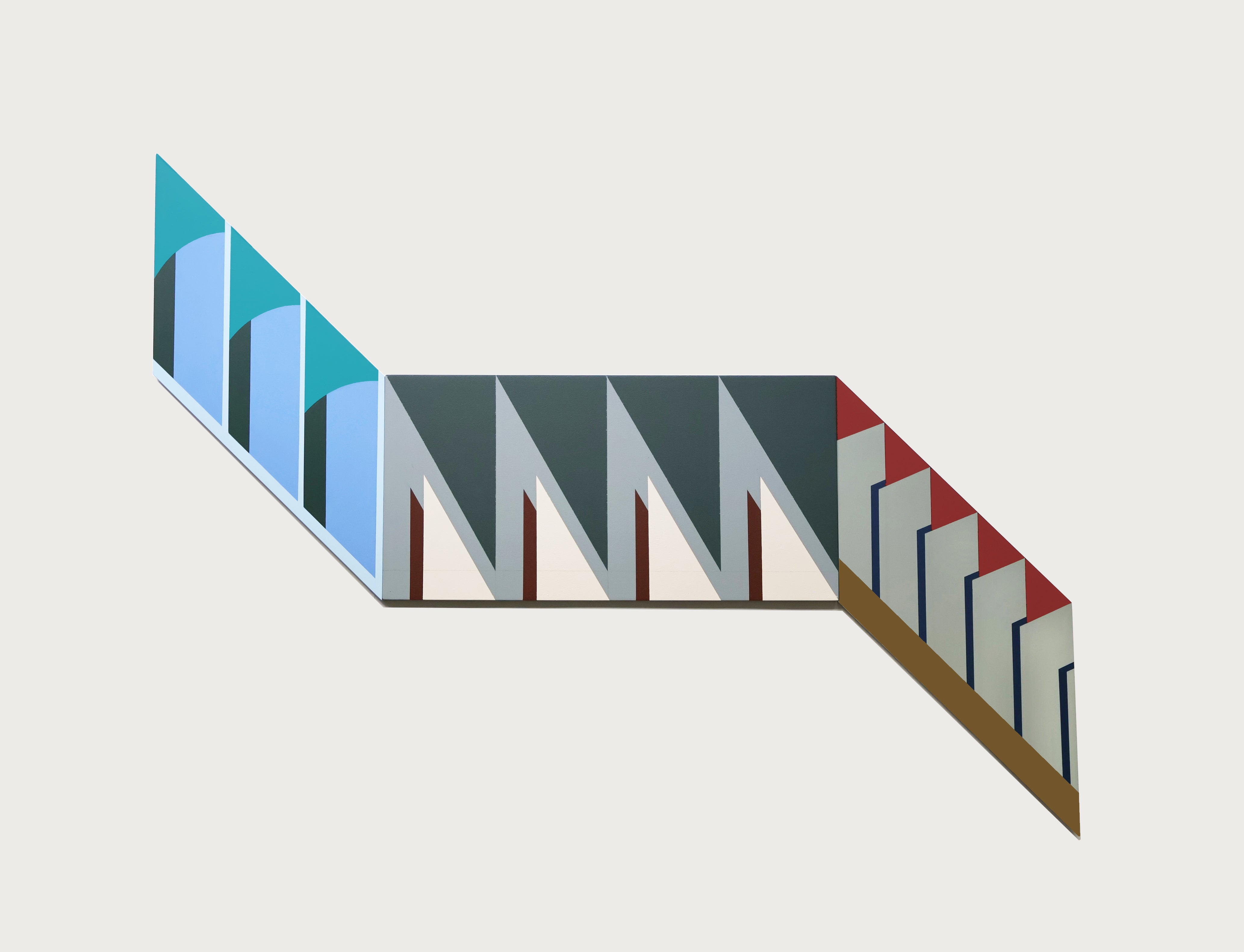
Shape Shifting: Untitled 17
28" x 41.5"
Wall Paint on HDF
2025
PRICE ON REQUEST
"In Shape Shifting, I continue to investigate the conceptual and material presence of perimeter fencing and gated architecture within urban environments. Boundary walls, high gates, and metal grills have increasingly encroached upon public space, establishing visible separations around residential compounds, government offices, private corporations, and gated neighbourhoods. Intersecting with militarisation, fragmented urban planning, and unequal mobility, these barriers have become a permanent feature of the city, steadily eroding lived public space.
My interest extends beyond their physical presence to the ways these structures regulate passage and shape behaviour, determining who can enter, who must wait, and who remains excluded. Many of these enclosed communities also privatise what are traditionally public responsibilities, including security, recreation, and infrastructure, reinforcing a broader “fortress mentality” within the urban landscape.
The works are intentionally assembled to resist a fixed or resolved endpoint, reflecting the instability and constant negotiation embedded within urban life."
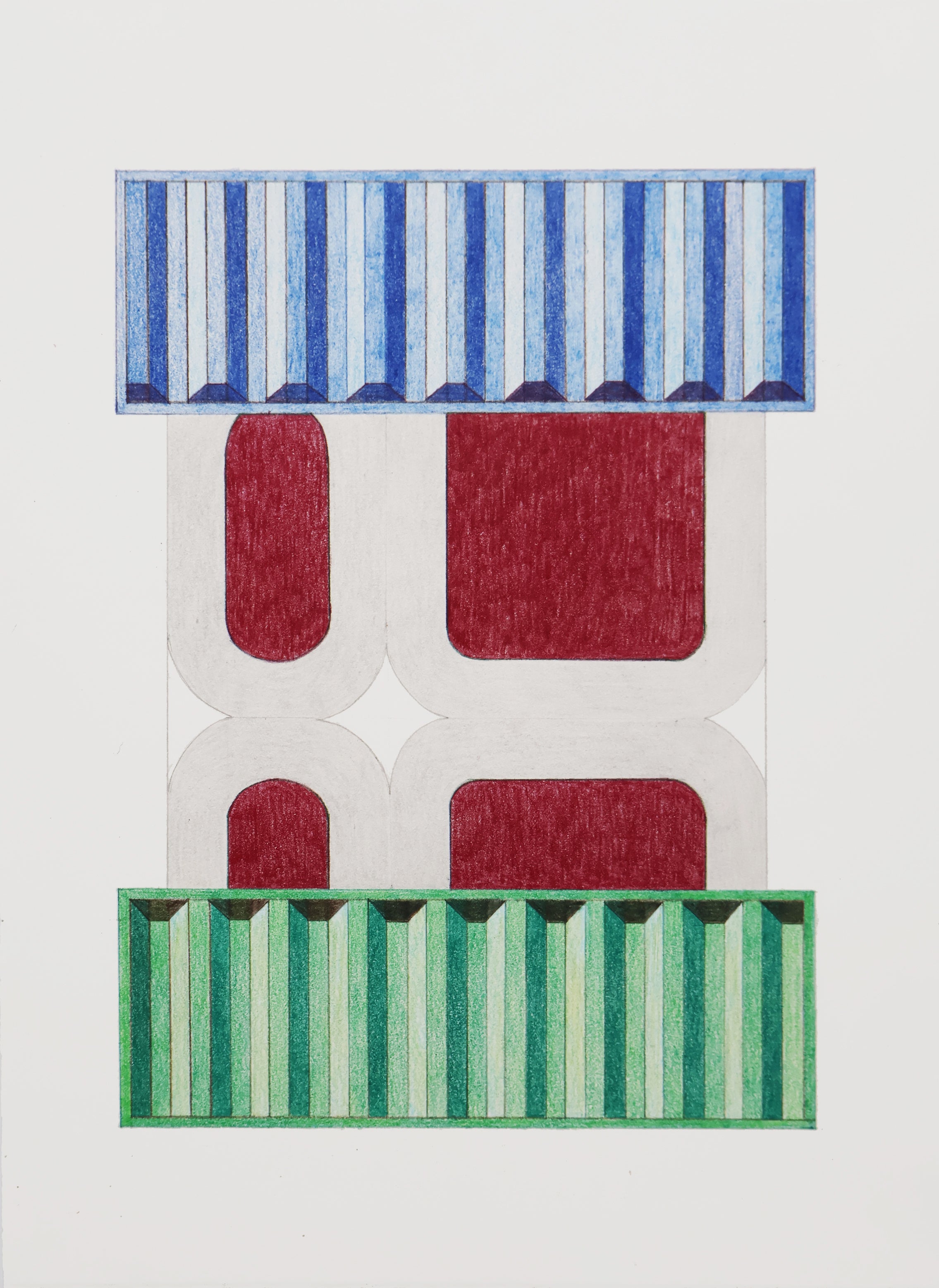
Protest Walls: Untitled 10
13" x 9.5"
Colored Pencil on Paper
2022
PRICE ON REQUEST
Protest Walls: Untitled 9
13" x 9.5"
Colored Pencil on Paper
2022
PRICE ON REQUEST
Protest Walls: Untitled 11
13" x 9.5"
Colored Pencil on Paper
2022
PRICE ON REQUEST
Protest Walls: Untitled 12
13" x 9.5"
Colored Pencil on Paper
2022
PRICE ON REQUEST
"In Protest Walls, I became increasingly interested in the duality embedded within certain forms and structures. The imagery of shipping containers references global systems of trade and infrastructure, yet in Karachi these same forms become associated with restriction, surveillance, security, and political control. In Karachi, shipping containers are frequently repurposed as temporary barricades during political protests, religious processions, moments of unrest, or heightened security operations. They are used to seal roads surrounding government institutions, high-profile buildings, and public gathering sites, while also forming stages and backdrops for political speeches and demonstrations.
I am drawn to the instability and temporality of these structures—the way they appear, disappear, redirect, and reorganise movement within the city. Within the compositions, grids, lines, and repeated geometric forms do not signal order or equilibrium; rather, they suggest boundaries, containment, negotiation, and interruption. At the same time, the works maintain a deliberate sense of visual restraint. Many of the drawings and painted forms are isolated against white or empty grounds, allowing the imagery to exist in suspended space. This minimal treatment shifts attention toward the psychological and symbolic weight of the structures themselves, while also creating ambiguity around scale, location, and permanence."
SEHER NAVEED
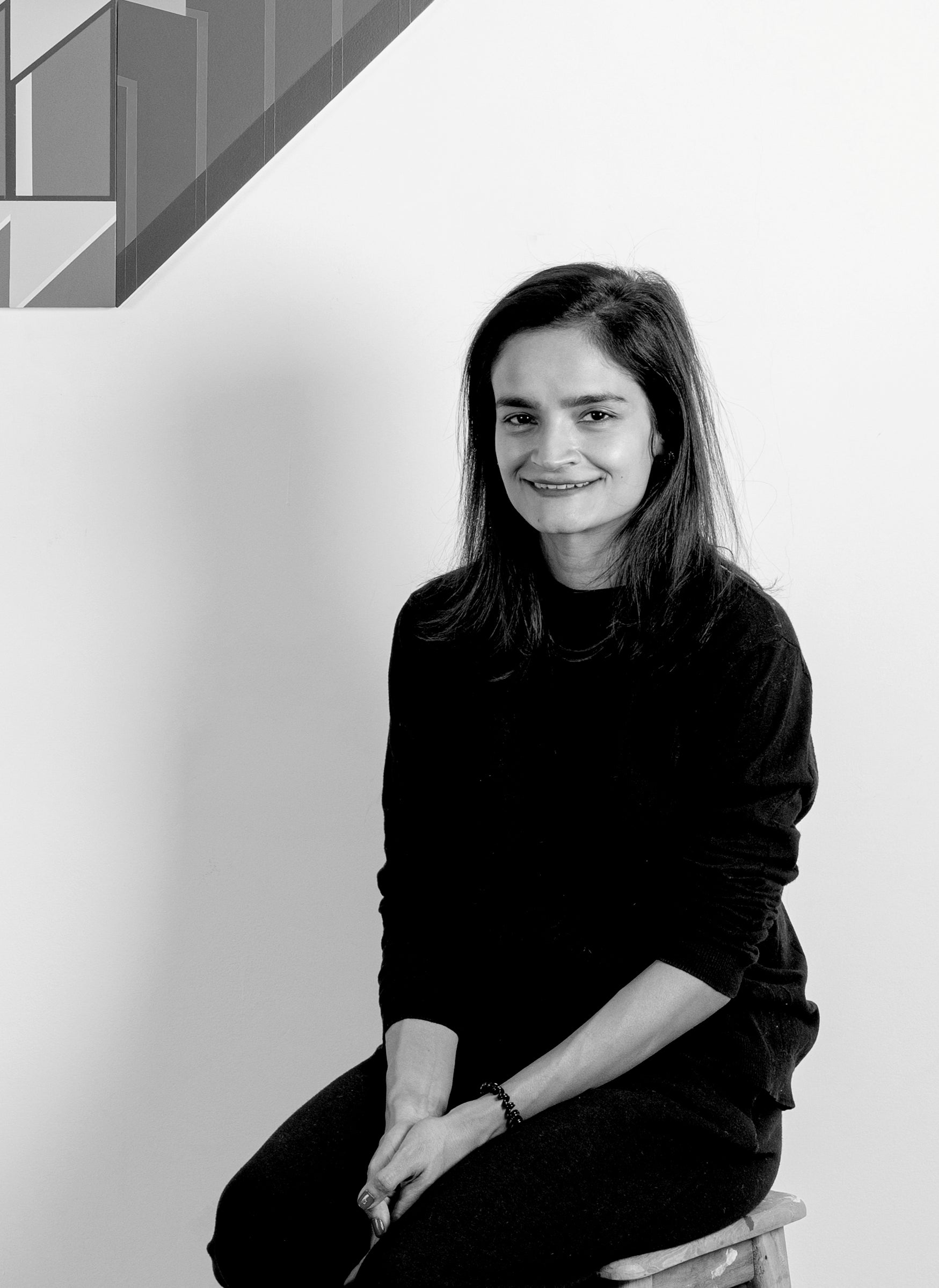
Seher Naveed (b.1984, Pakistan) is a Karachi-based artist with over a decade of experience in visual arts and academia. Her practice explores the socio-political development of urban environments and their impact on everyday life, with a particular focus on Karachi and its evolving political and infrastructural landscape. Through this lens, her work examines how architecture and infrastructure reflect collective aspirations within contexts shaped by political instability.
Seher earned a BFA from the Indus Valley School of Art and Architecture (IVS), Karachi and an MA in Fine Art from Central Saint Martins College of Art & Design, University of the Arts London (UAL). Currently, she is Associate Professor at IVS, where she teaches courses in drawing and painting. Her work, Tips( 2019), was recently commissioned by Art Jameel for the exhibition Global Positioning Systems at Jameel Art Center, Dubai.
She is also the co-director of the Urban Repository Archive (URA), a project preserving student research on Karachi’s evolving conditions, and serves on the editorial board of Hybrid—a transdisciplinary research journal at IVS.

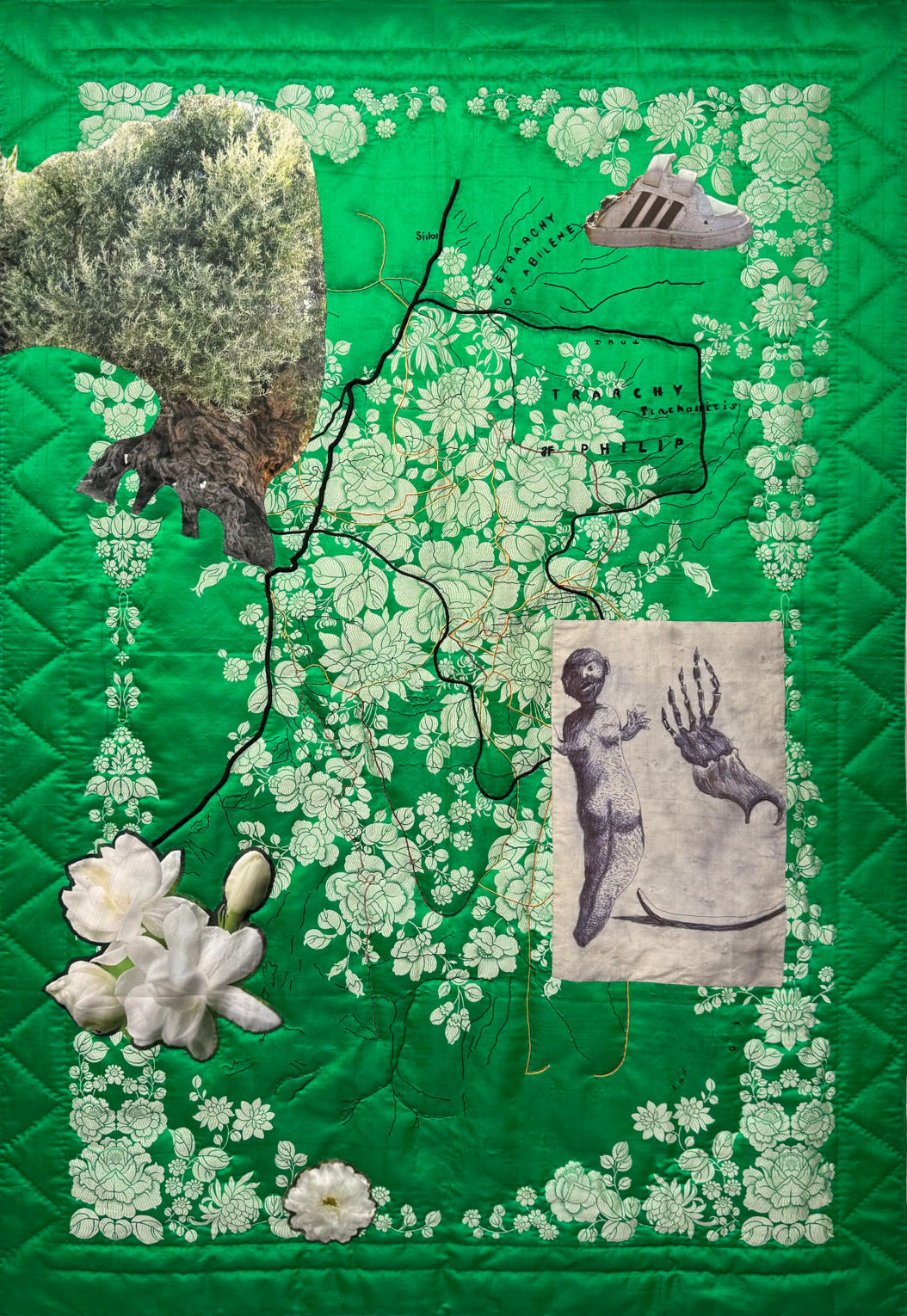
A sneaker sits beside the wandering line of political maps. A wildflower blooms with quiet resilience, despite the crisscrossing global geometries that try to contain it. A piece of old silk carries the weight of inheritance. Each element arrives with its own history, stitched into a world that holds the micro side by side with the macro. The domestic and the political weave alongside each other as an unlikely couple.
It is a reminder: these small and tender moments, these human artifacts and ephemera, carry just as much weight of any historical archive. Risham Hosain Syed’s textile-based compositions layer together intersecting memories and meanings with a quiet considered care. Her training in miniature painting lives in the precision of her hand, and in the way detail accumulates slowly across the surface as a growing system. In her works, memory becomes gathered, passed down, and held between many hands.
“Imbued with the weight of history, these fragments bear witness to the human capacity for endurance. The vintage Chinese jacquard silk panels I inherited from my late mother, provided me with a base to speak about a complex narrative of power dynamics and the human cost of conflict. The printed maps expose the stark reality of territorial disputes, where political lines supersede human lives. The works invite viewers to confront the entangled threads of our existence, where past and present, and local and global intersect. This convergence reveals the fissures in our shared humanity and the resilience that bridges them.”
Texts and Contexts: The Olive Tree Series I
72" x 52"
Mixed media on vintage chinese jacquard silk panel
2024
PRICE ON REQUEST
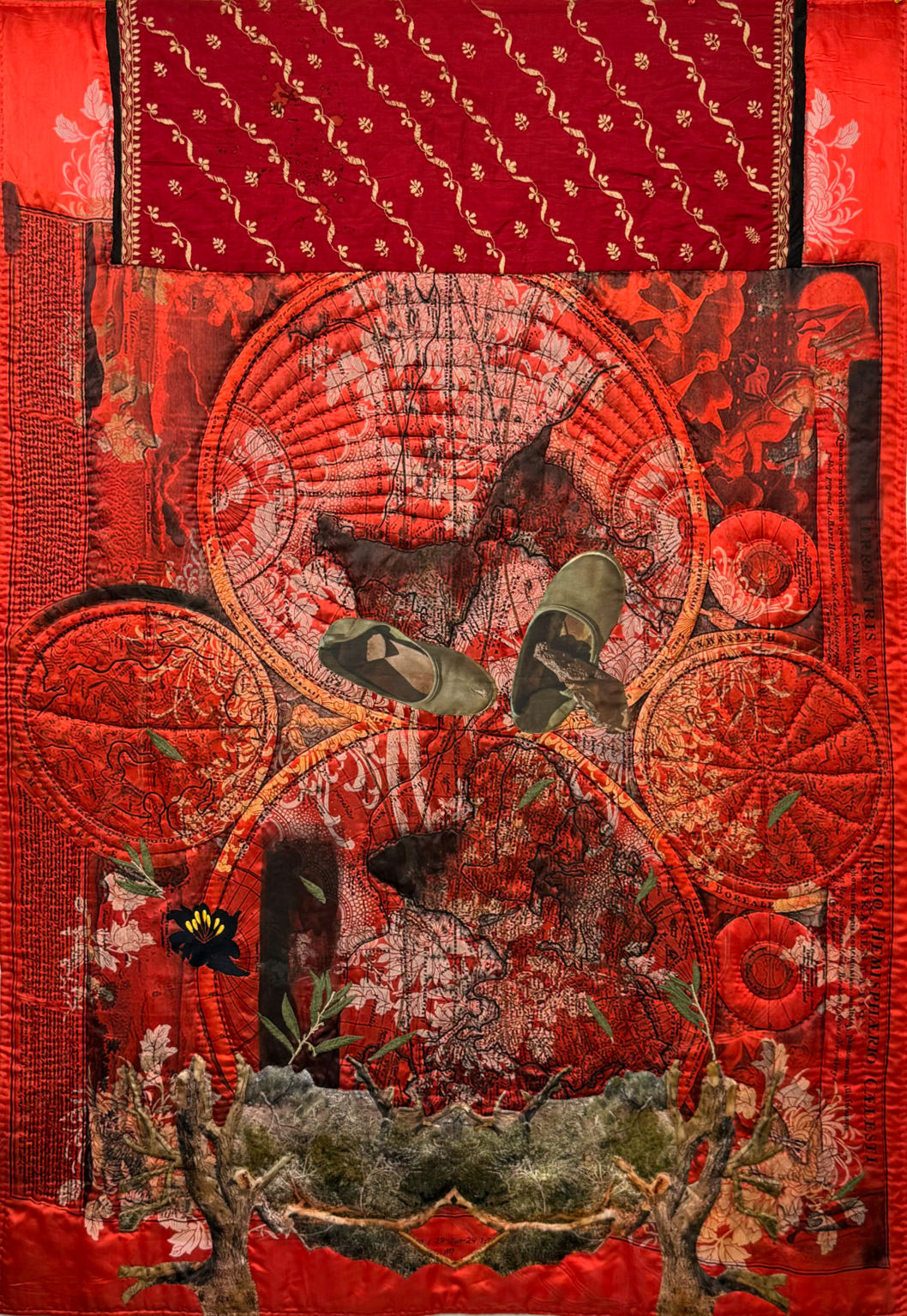
Texts and Contexts: The Olive Tree Series IV
72" x 52"
Mixed media on vintage chinese jacquard silk panel
2024
PRICE ON REQUEST
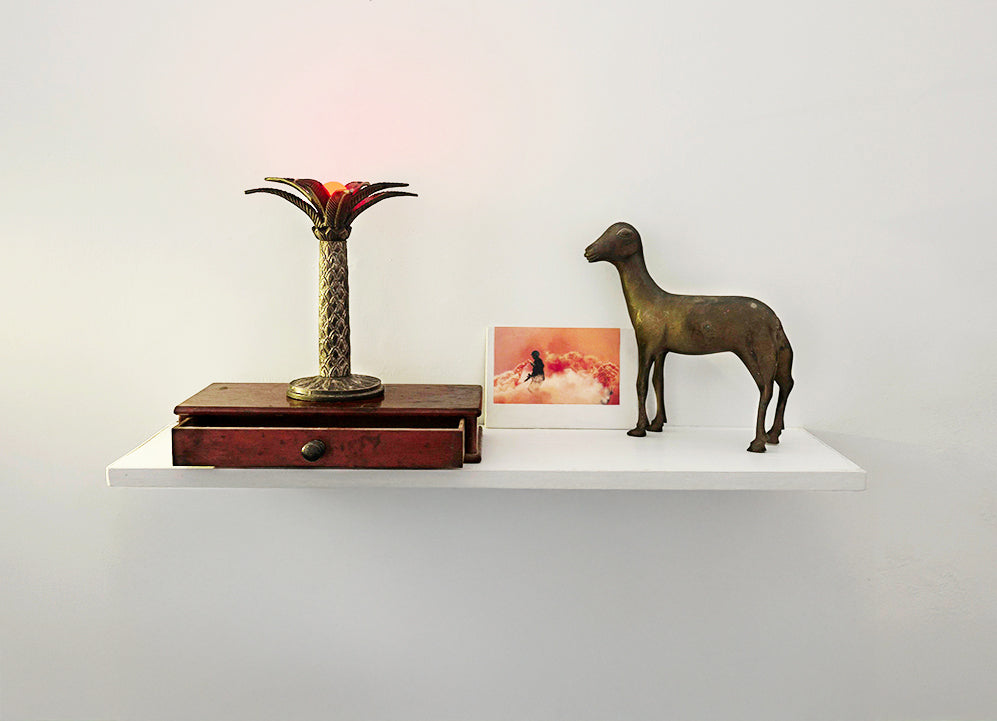
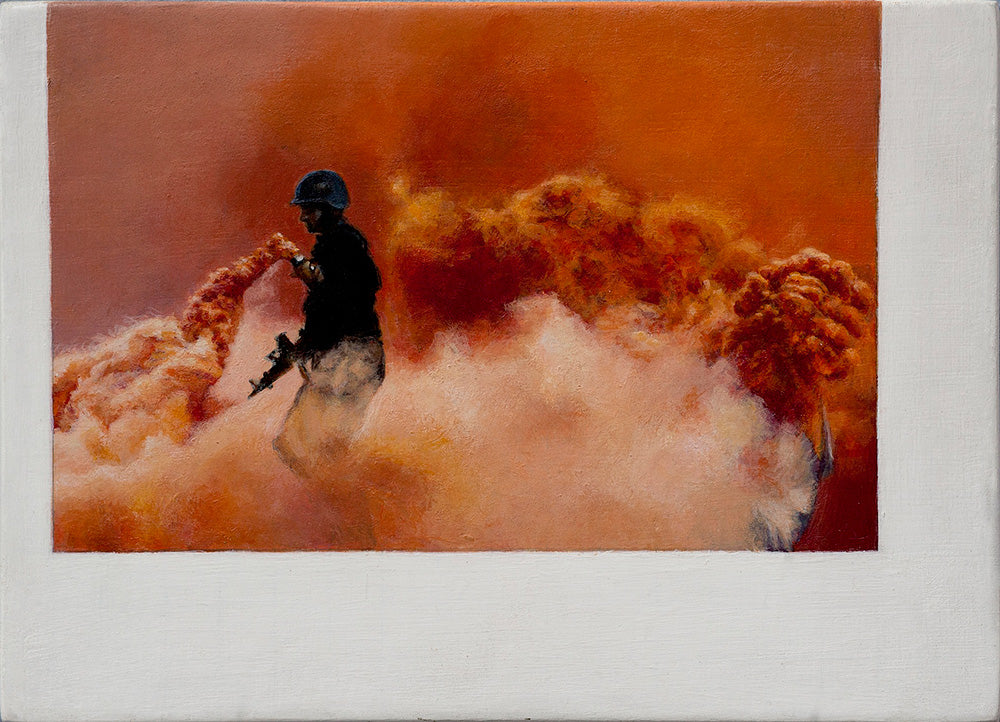
A Chronicle Punctuated
Mixed media & Oil Painting
2016
PRICE ON REQUEST
Risham Hosain Syed
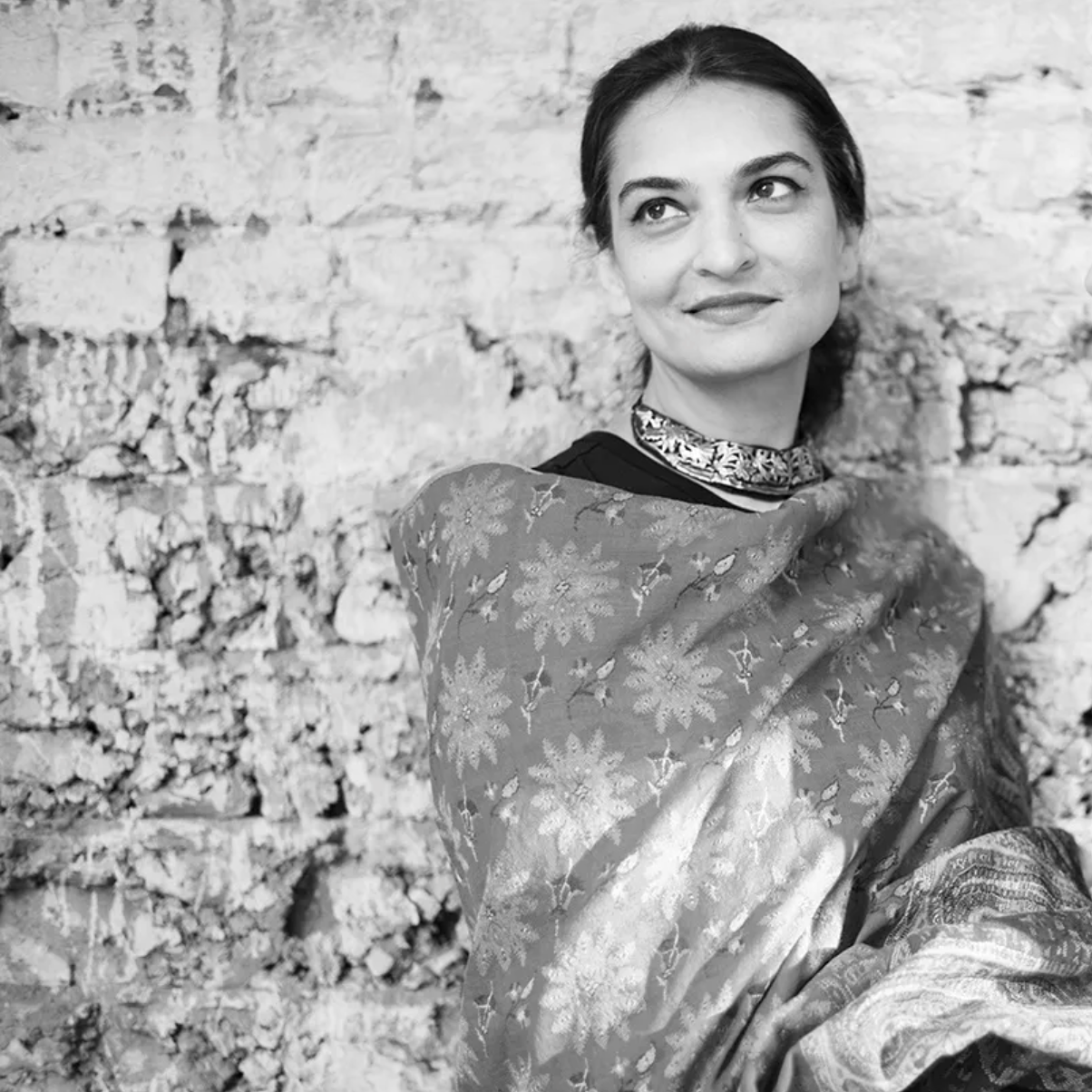
Risham Syed (b. 1969, Pakistan) received her MA from Royal College of Art, London and BA from National College of Arts, Lahore, where she studied painting and traditional miniature painting. She recently exhibited her new body of work Unn, Pani, Sut (Grain, Water, Truth) (2024) at the Sharjah Biennial 16: ‘to carry’ in 2025. Risham lives and works in Lahore and heads the Visual Arts Department at the School of Visual Art & Design, Beaconhouse National University (SVAD, BNU).
Risham has shown widely nationally and internationally including Fukuoka Triennial, Harris Museum, Preston, Mohatta Palace Museum, Karachi, Devi Art Foundation, Gurgaon, among others. Risham was the recipient of the prestigious ABRAAJ Capital Art Prize (2012). Her works are part of important public and private collections. Her recent projects include her solo show at Manchester Art Gallery in Manchester where her work conversed with the permanent collection of 18th, 19th Century painting. During this time she was also part of a show at Whitworth Art Gallery in Manchester. She has also shown at the Asia Pacific Triennial in Brisbane, Hangzhou Triennial of Fiber Art in China.
Working with metal, found forms, and juxtaposed elements, Masooma Syed’s sculptural objects feel pulled from a world beyond our own. These are artifacts of frozen wonder: small, mythic, and quietly alive. Each held in a state of suspension, as if time has slowed around it. Talismans that carry a charge.
She describes materials as having souls: "materials can gossip, chant, demand and react to my intentions if I allow myself to listen." Syed’s objects are crafted in silver, copper, bronze, gold, stone, and organic materials, feeling forged from the earth. A silver eye with a pearl pupil gazes from a copper lid. A bouquet of impossibly delicate metal flowers rises from a glass bottle of amber liquid. A bird perches on a ring, its weight somehow wrong. Too heavy, too tender.
Her scale draws you closer, asking for a different kind of encounter. These are pocket-sized totems that carry enormous weight. You could wear one. You could worship one. You could spend an afternoon locked inside one.
She calls herself a feminist without reservation, and the body's containment, adornment, and vulnerability are always present in her work. “When life resists coherence and reveals itself only in fragments—unjust, false, and unrelenting—I turn to poetry, the poetry of crime.”
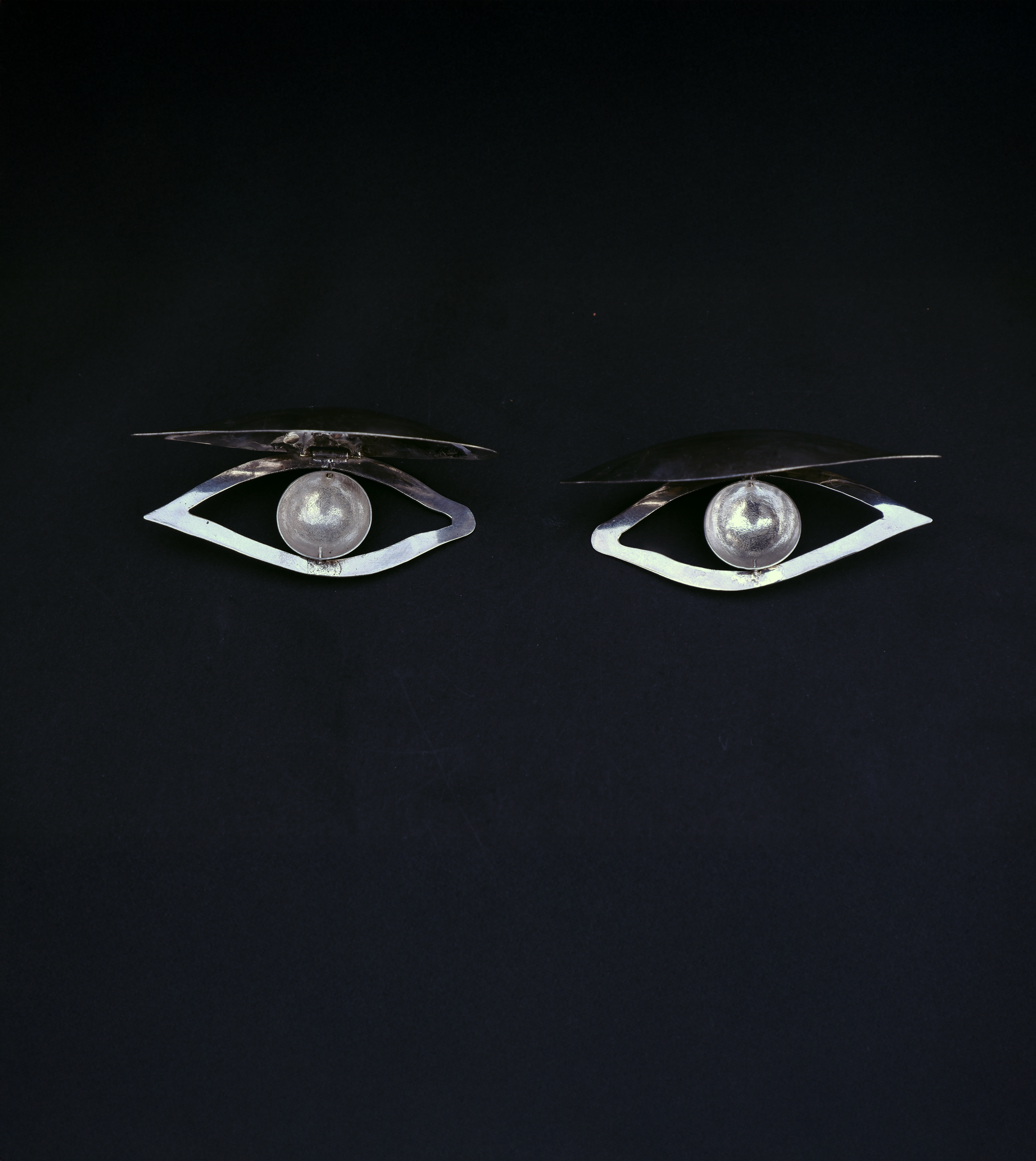
Between You and Me
2.5” x 1.3”
92.5 Pure Silver, hand fabricated
Wall Installation / Wearable sculpture
2024
PRICE ON REQUEST
Kinetic eyes (eye lid opens and shuts. Eye ball rotates convex /concave. "This work reflects on gaze as both location and lens, while the eyes – positioned as if watching back – place the viewer within a quiet , reciprocal act of looking “outside the center”. This becomes an ironic condition of seeing, half seeing or closed eyes ( I/Eye witness ) and connects."
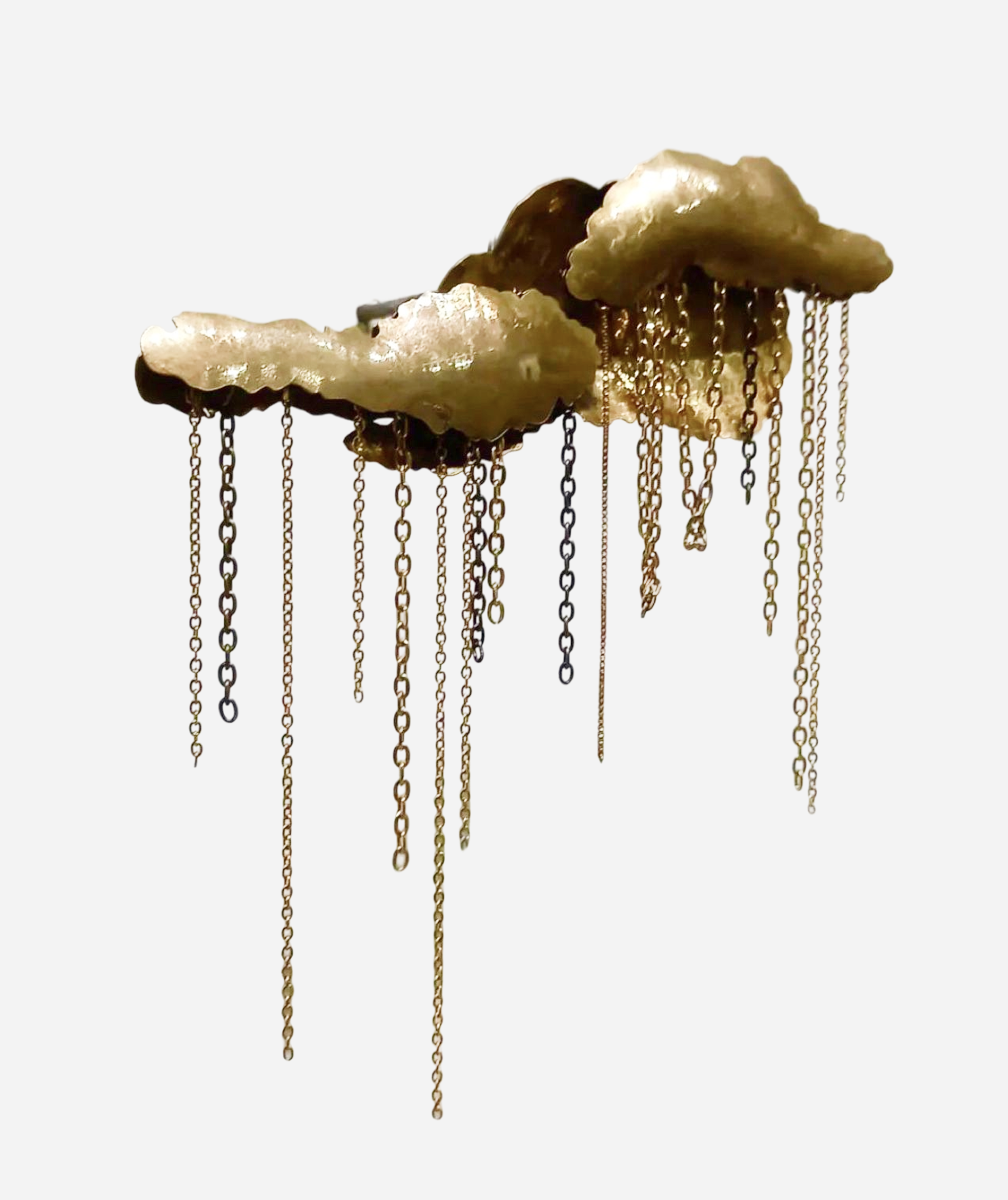
Golden Clouds /Peetal ke badal
4.5” x 6”
Brass Kinetic Sculpture
(open and closes to let rain /chains drop)
2025
PRICE ON REQUEST
"A world where softness turns hard and heavy such as clouds of brass and movement of rain as chains. This refers to shifting natural and human conditions. Brass Clouds operates through hinges releasing chains as rain is tongue in cheek. A gentle satire on a tiny intimate scale of something infinitely huge."
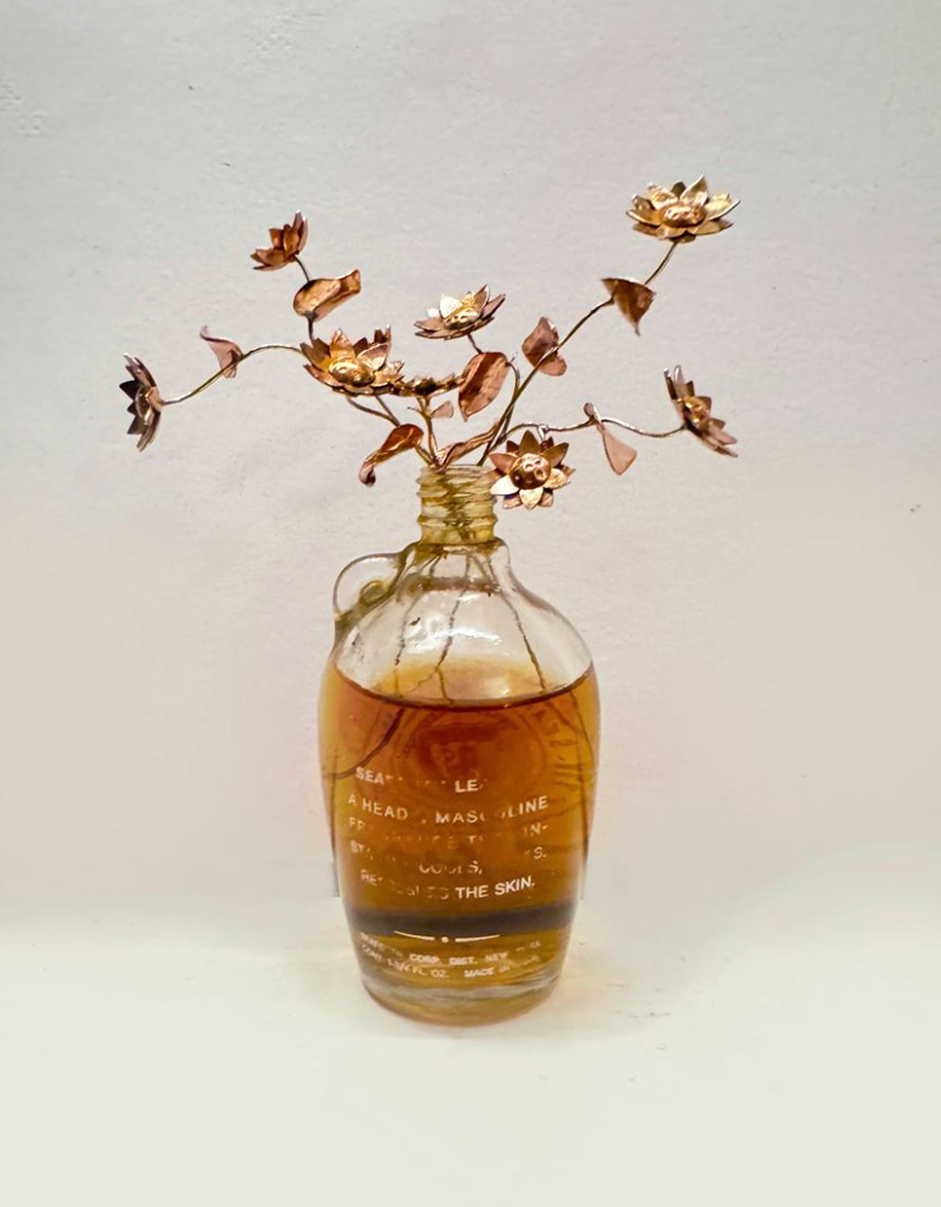
Sunflowers Soaked in Rum
3” x 2” x 5”
Copper flowers, Rum, and old bottle of perfume
2024
PRICE ON REQUEST
"Within an old perfume bottle, radiant copper sunflowers steep in rum- an intimate chamber of scent, memory and time. This holds a quiet melancholy of human condition, held by a fragile faint gleam."
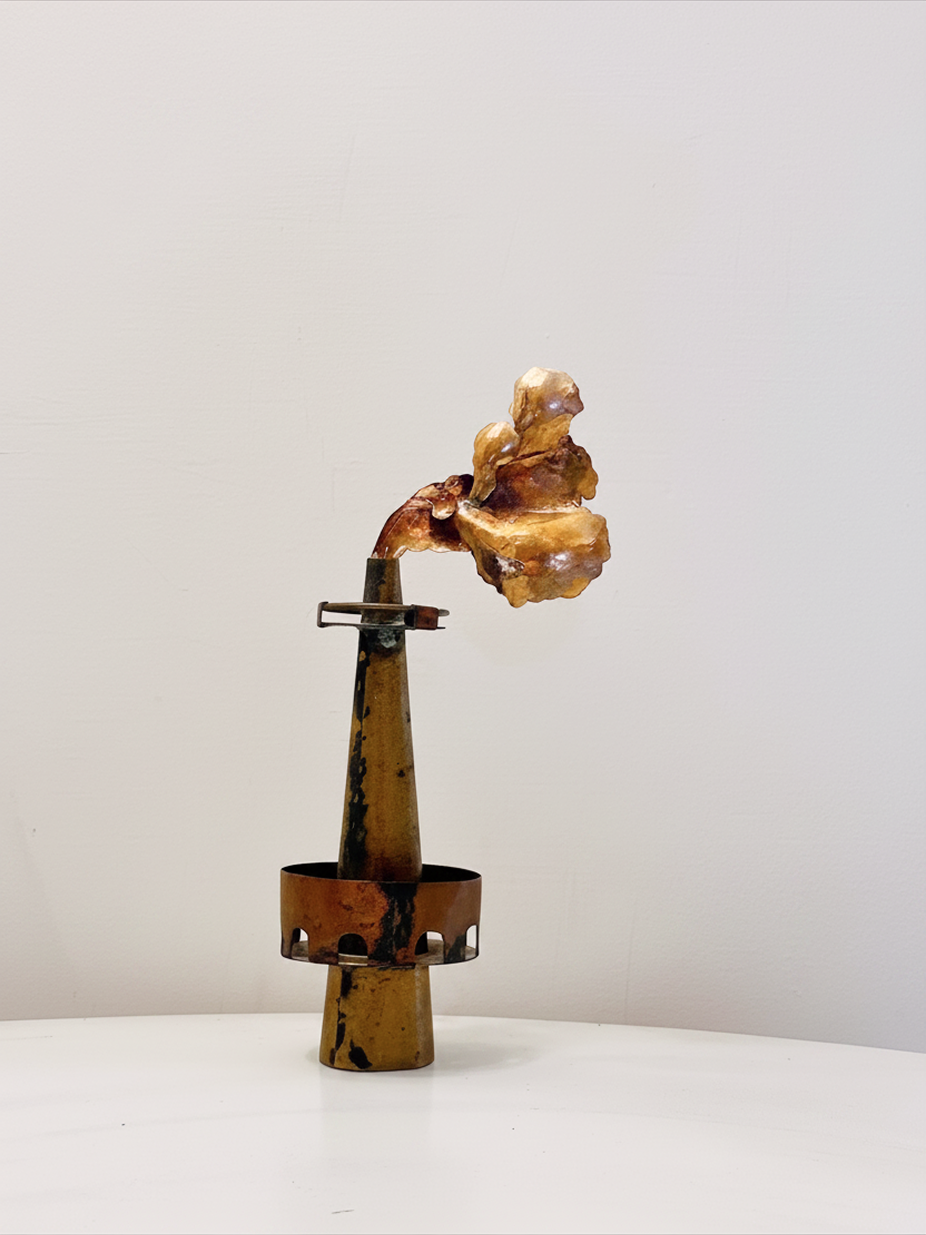
Smoke
Kiln: 6” x 1” Smoke: 3’’ x 2.5”
92.5 Pure Copper and oxidized patina brass
Wall Installation / Smoke is wearable sculpture
2024
PRICE ON REQUEST
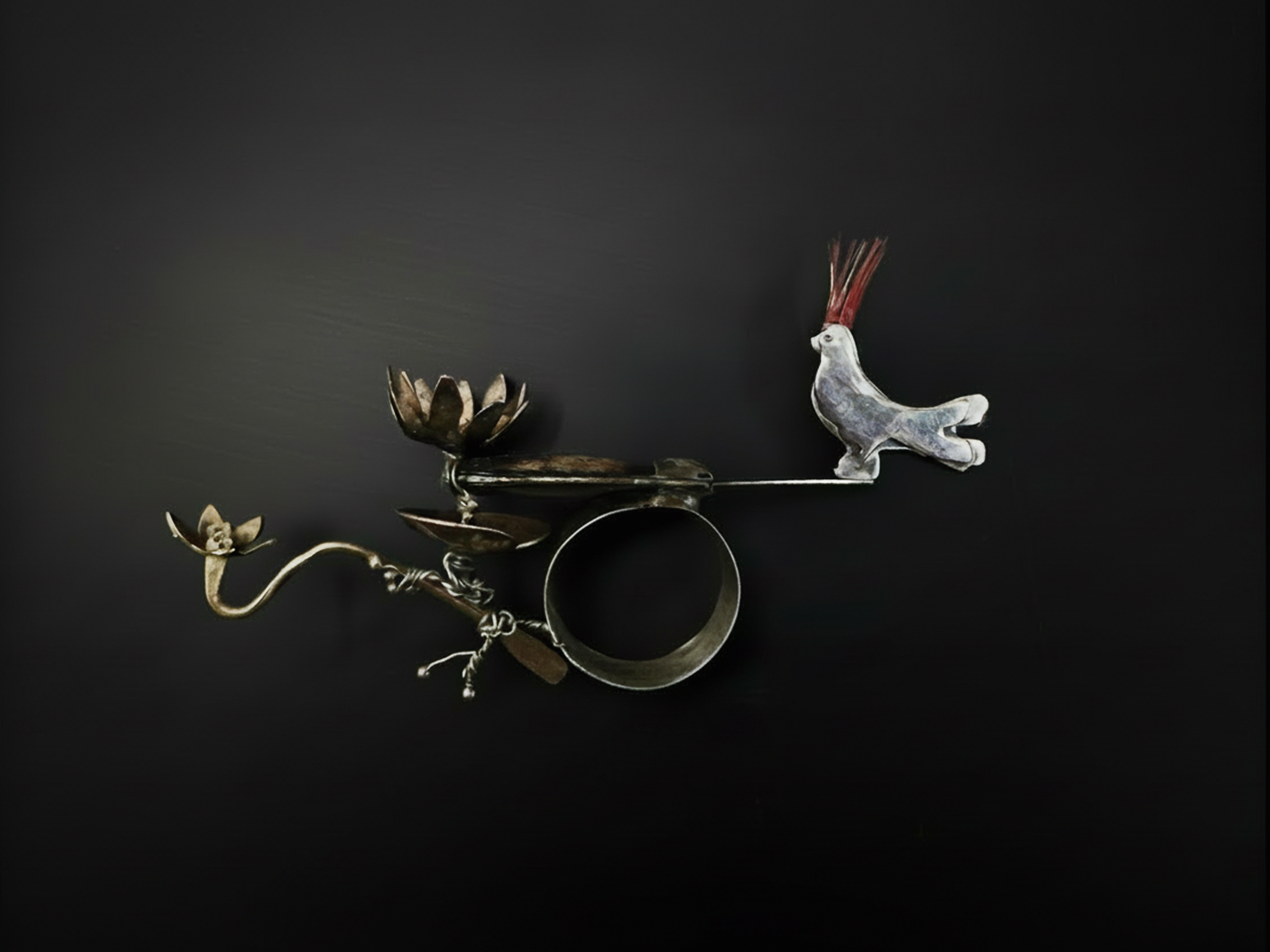
Lali / Myna perched on the blade of knife
to meet golden lotuses
3.5” x 2” and variable
92.5 Pure Silver, gold plated copper and silver,
brass, fake blade and feather.
Kinetic Sculpture
2025
PRICE ON REQUEST
"The myna is known for its alertness and proximity to human spaces. Its its adaptive pause at the edge of blade is a passage drawn towards golden lotuses that signals luminosity and renewal. A poetic rendition of a delicate threshold between instinct and stillness."
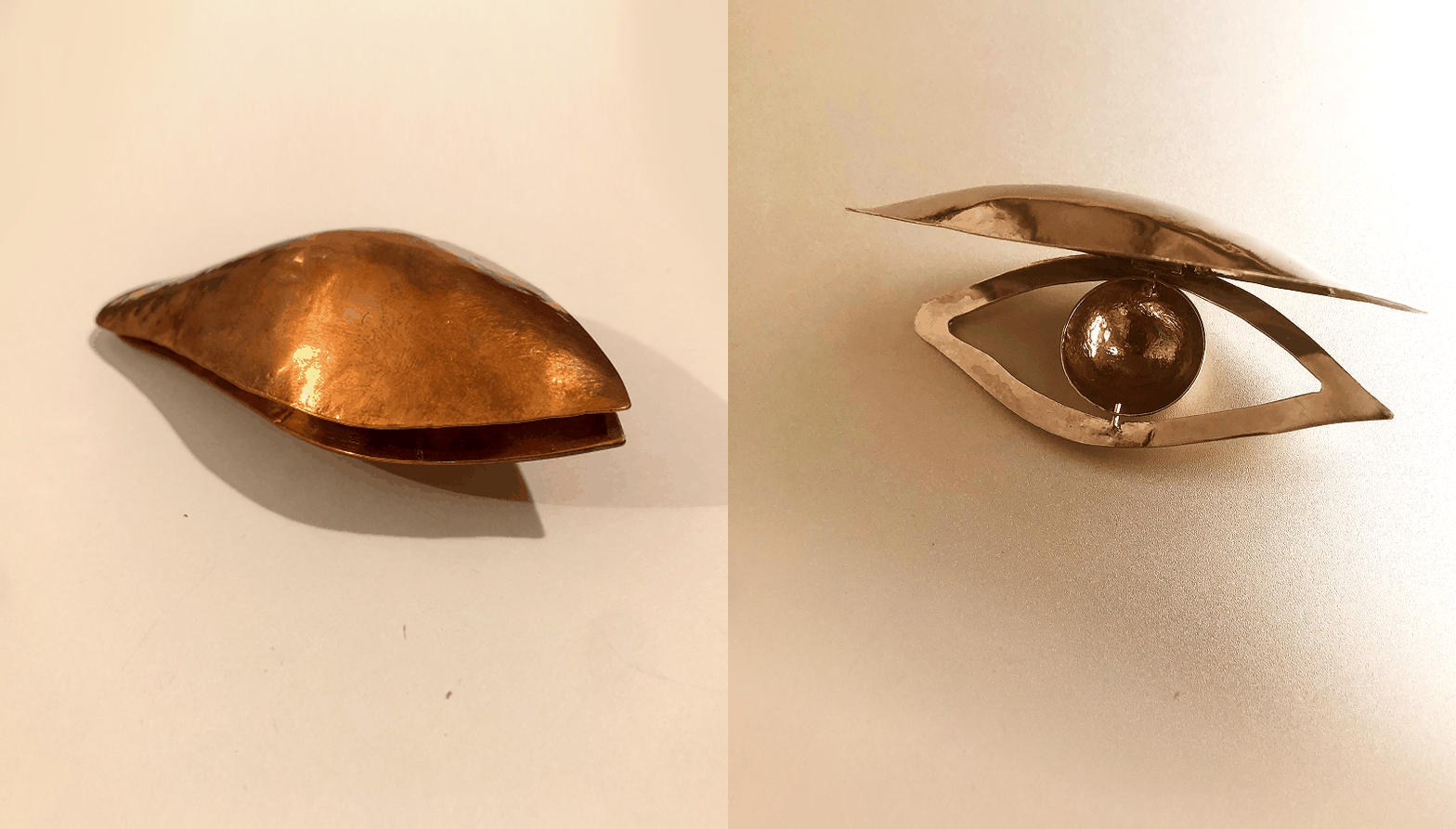
Third Eye
3.5” x 2.5” and variable
Copper plated MS, Kinetic Sculpture
Eyelid opens and closes, Eyeball rotates
2023
PRICE ON REQUEST
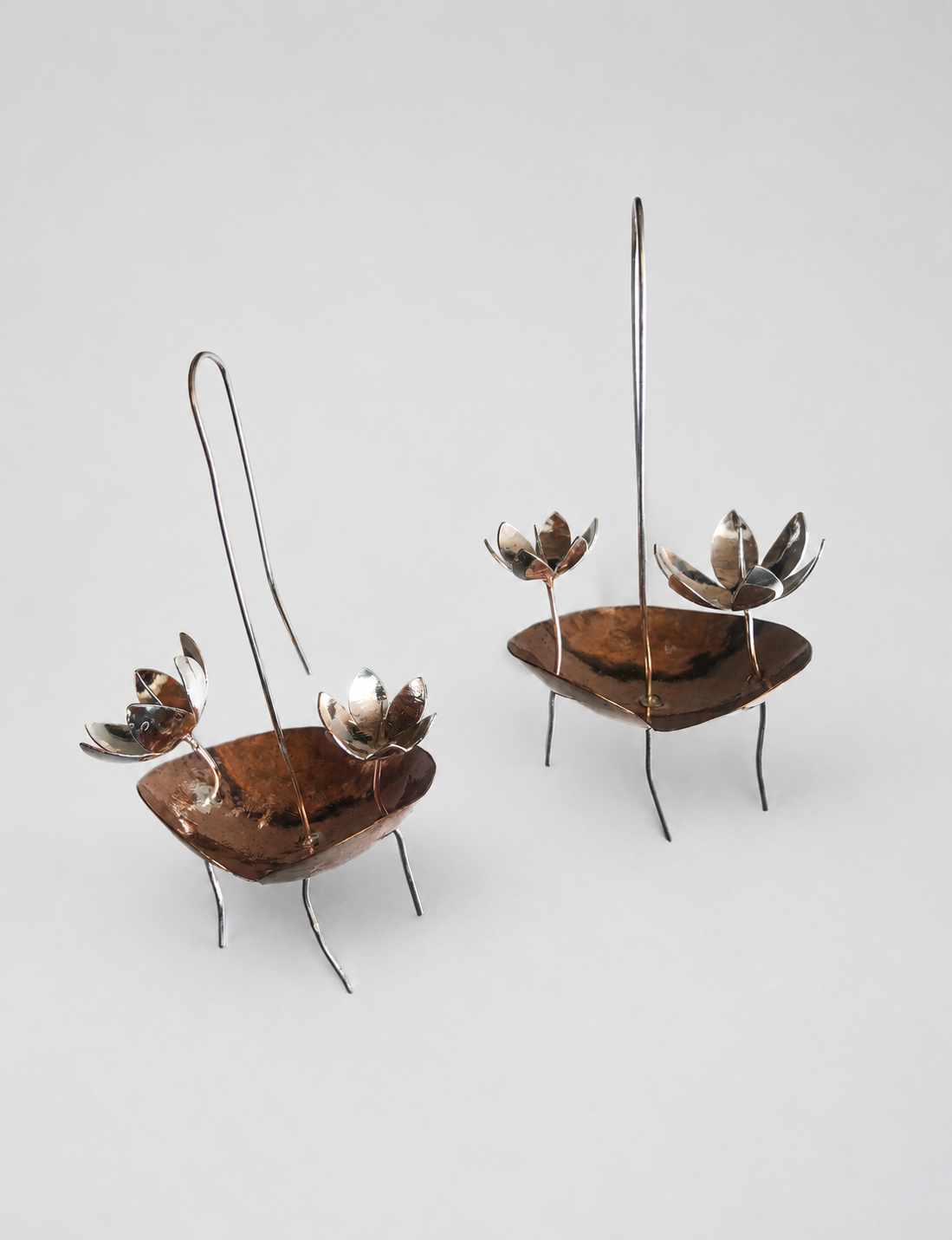
Full Blossomed Lotuses
3.5” x 1.5” each
92.5 pure silver, copper, and pearls
Wearable Sculpture
2024
PRICE ON REQUEST
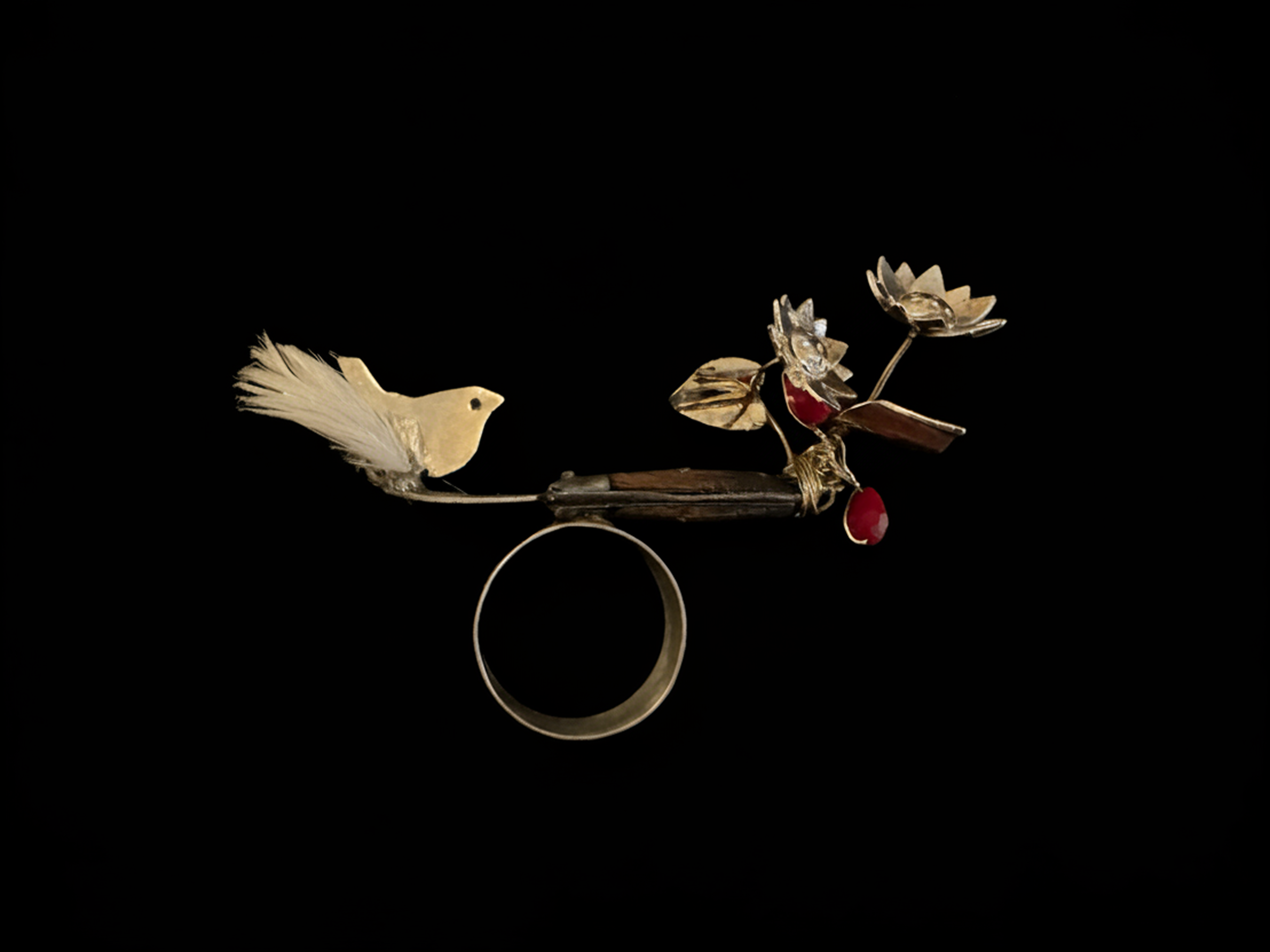
Bulbul perched on the blade of knife
to meet sunflowers
3.5” x 2” and variable
92.5 Pure Silver, silver plated copper,
fake knife, glass beads and feather
Kinetic sculpture
2025
PRICE ON REQUEST
"A fragile encounter where tenderness is held at the edge of danger, yet the blade turns inward, refusing its violence. The bird ‘bulbul rests in suspended alertness, drawn towards sunflowers as if towards softened horizon. Between them sharpness becomes false, and proximity replaces threat - an uneasy balance of care, risk and attraction."
Masooma Syed
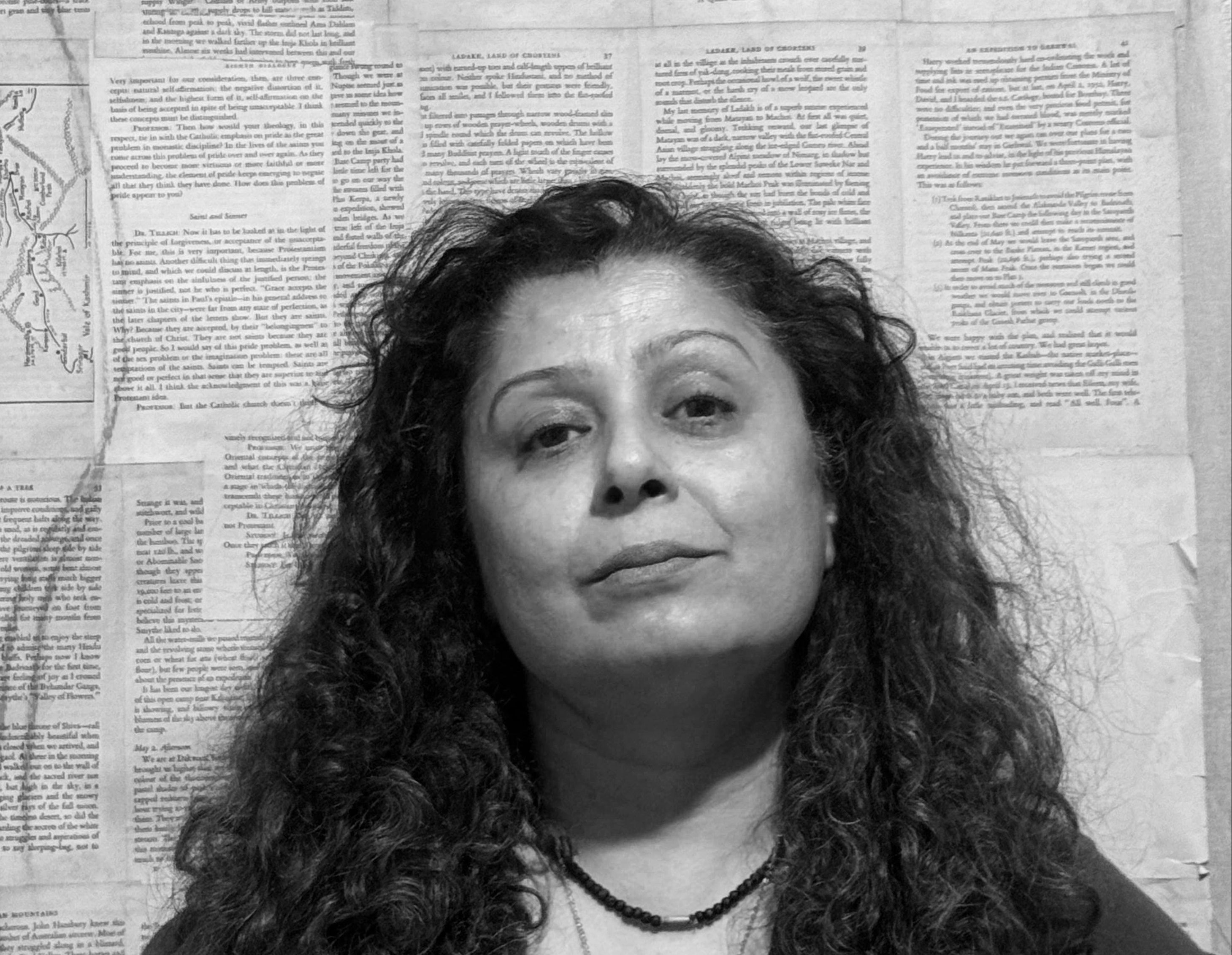
Masooma Syed (b. 1971, Pakistan) is an artist and art academic who has lived and worked throughout South Asia. Syed’s art practice involves intricate processes, layered ideas of duality, reality and fiction in nation theories/culture propaganda and history as battleground.
Her works have been exhibited at the Kiran Nadar Museum of Art and the Devi Art Foundation, New Delhi; the Fukuoka Asian Art Triennale, Japan; the Harris Museum, Preston, UK; the Metropolitan Art Museum, Tokyo; the apexart, New York; the Kunsthalle Fridericianum, Kassel, Germany; the NGMA (National Gallery of Modern Art), Mumbai, India. She has also shown at several galleries, such as the Rohtas 2 Gallery, Lahore; the GALLERYSKE, New Delhi and Bangalore, India; the Vadehra Art Gallery, New Delhi. She has participated in several international art residencies and has vast teaching experience in South Asia, in art schools in Pakistan, India, Nepal and Sri Lanka.

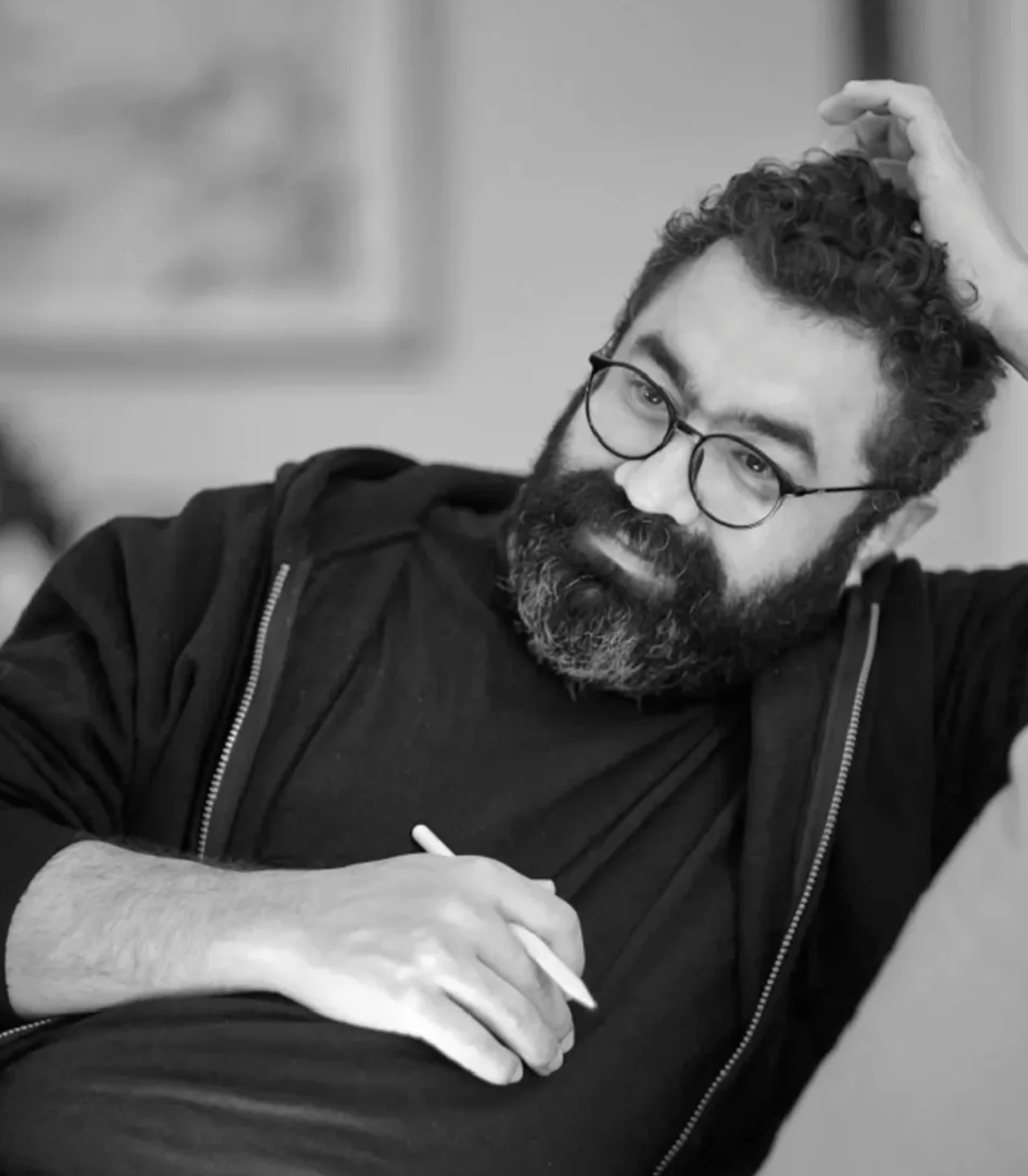
Curator & Artist Muzzumil Ruheel
House of Spider Silk is curated with Muzzumil Ruheel, a Karachi-based visual artist whose work examines how we perceive, remember, and arrive at meaning, and the unseen orders that shape those acts beneath our awareness. Drawing on psychology, philosophy, and sustained observation, he is concerned with the systems we live inside without noticing: the frameworks that organize thought and feeling, the distance between what we see, say, remember, and truly know. His practice treats these conditions as material: following where they steady us and where they constrain, where they clarify and where they close in. It asks the viewer to slow down, to look, and to find themselves within these spaces.
Working across painting, sculpture, text, and installation, his work has been exhibited internationally at institutions including Universität der Künste Berlin, Glynn Vivian Art Gallery, and Museo Diocesano Carlo Maria Martini, and at the Cairo Documenta, Lahore Biennale, and Young Moscow Biennale, with solo projects at Art Dubai and India Art Fair. His work is held in private and institutional collections worldwide.
View his solo show "On Emptiness" with Friday Gallery, and explore more works at muzzumilruheel.com
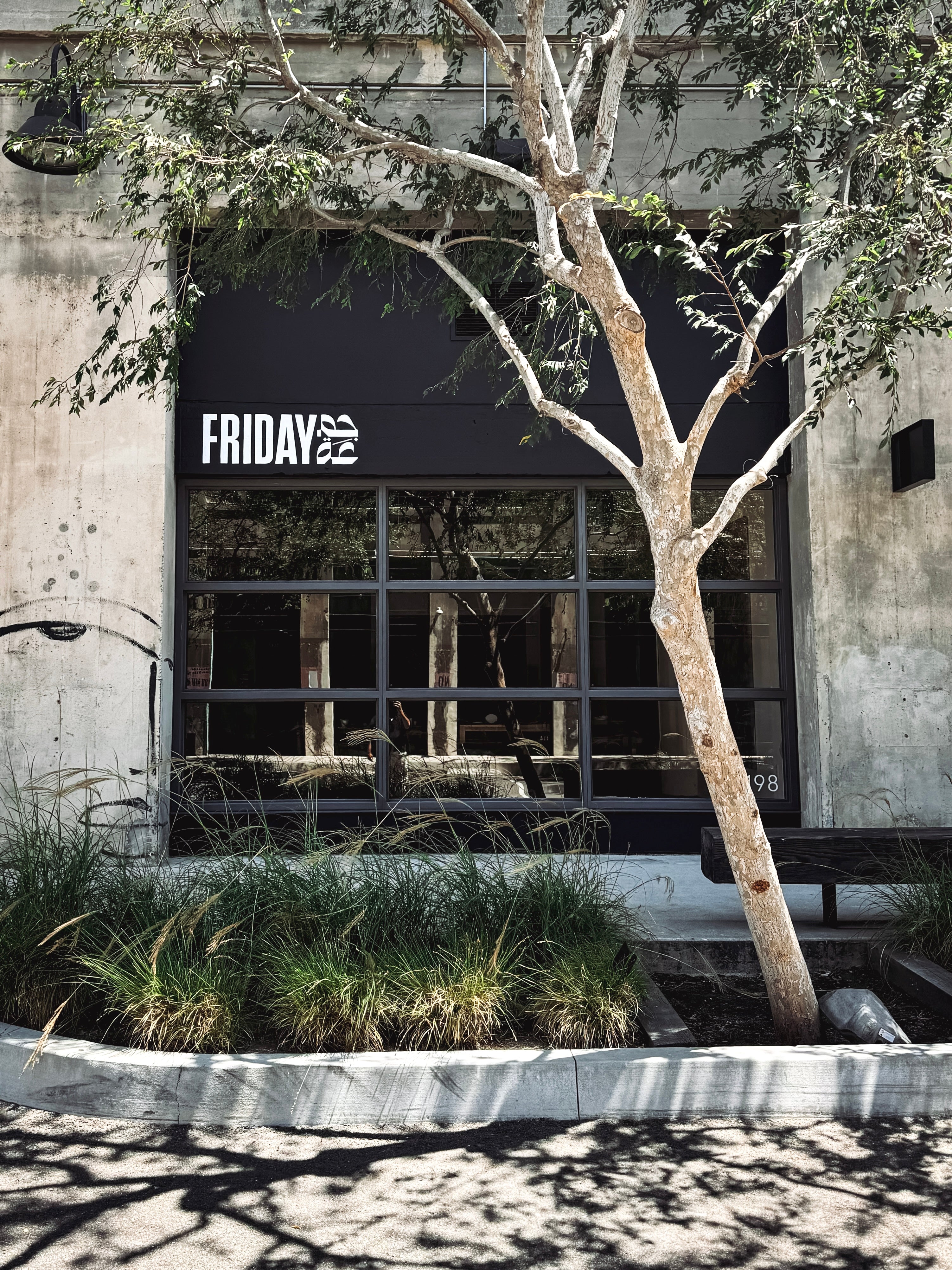
FrIDAy GALLERY
Friday Gallery is a Los Angeles gallery and cultural salon series dedicated to brave contemporary voices from the Global South. Through seasonal exhibitions, cultural salons, interdisciplinary programming, and cross-cultural collaborations, the gallery creates space for new cultural narratives that bridge geographies, histories, and perspectives.
Each Friday season is anchored in a rotating theme, with the exhibition, events, and partnerships bound together in a shared spirit. From South Asian maximalism, to the surrealist visions of feminist Iraqi photographers, to queer gothic brujas in Mexico, Friday exists to peel back old divides and celebrate the cultural voices of tomorrow.
Our name (جمعة) comes from the Middle East tradition of honoring Friday as a time of connection, presence and reflection in community. Friday is a home for the forever curious, hungry to see the world with new eyes.